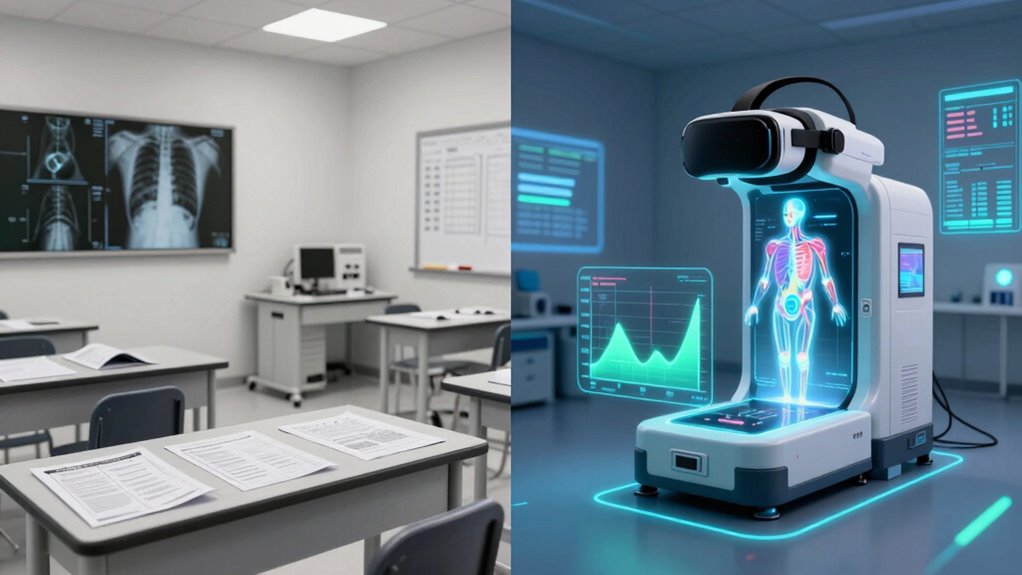
It’s not just about convenience. VR-trained students consistently outscored peers using traditional methods in radiographic proficiency. They got better at image quality assessment, equipment handling, and patient positioning—basically all the things that matter when you’re trying not to zap someone’s elbow when you meant the shoulder.
Even students with lower visuospatial skills, who usually struggle with imaging concepts, showed major improvement. No gamer skills or prior VR experience needed—everyone benefits equally. Talk about a level playing field.
Even those who struggle with spatial skills thrive in VR—no gaming experience required. It’s a true equalizer in radiography training.
And students aren’t just tolerating it—they’re *loving* it. Over 90% said VR helped with radiography learning, nearly all found the x-ray equipment realistic, and 91% thought it was useful.
Eighty-two percent said they’d use it again. Sure, 37% were super satisfied despite sky-high expectations, which says something about how good the tech really is. They felt more confident, better prepared, and yeah, even more ready to tackle a real wrist x-ray without panicking.
Studies show VR boosts technical skills, image evaluation, and even self-assessment. Over two dozen studies back this up with performance improvements, engagement spikes, and more positive outcomes than a puppy at a park.
Equipment layout turned out to be the biggest factor in training success—which makes sense if you’ve ever walked into a radiology room and stood there, confused by all the wires and gadgets.
With VR, now they can mess up in a safe space, learn fast, and walk in feeling like they’ve already been there. This aligns with safe environments for high-stakes training identified in medical education research.
Just as AES-256 encryption protects sensitive data in smart home systems, VR simulations keep patient data secure while providing realistic training scenarios.
This aligns with findings that immersive technologies lead to measurable performance enhancement in medical training.
References
- https://pmc.ncbi.nlm.nih.gov/articles/PMC11094427/
- https://www.frontiersin.org/journals/digital-health/articles/10.3389/fdgth.2024.1365345/full
- https://pmc.ncbi.nlm.nih.gov/articles/PMC8851326/
- https://www.aamc.org/news/future-or-fad-virtual-reality-medical-education
- https://onlinelibrary.wiley.com/doi/10.1002/jmrs.868
- https://www.spiedigitallibrary.org/conference-proceedings-of-spie/13411/1341116/Evaluating-the-benefit-of-immersive-virtual-reality-in-training-radiology/10.1117/12.3046834.full