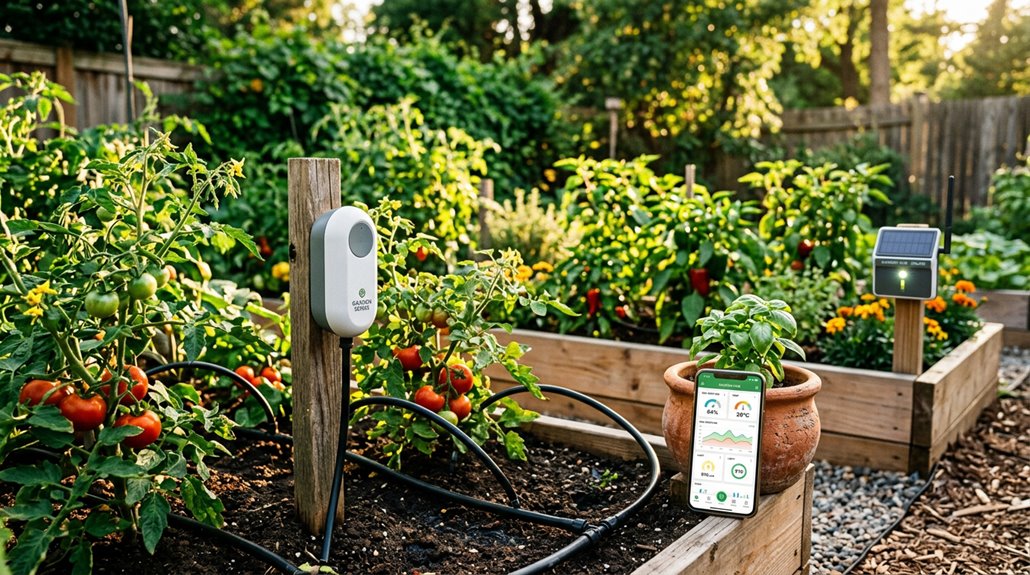
You’ve got a garden, and you want it to thrive without babysitting it constantly. Smart outdoor garden technology makes that possible, combining sensors, automated irrigation, robotic mowers, and AI-driven apps into one manageable system. Whether you’re tracking soil pH or scheduling watering cycles remotely, these tools do the heavy lifting. And there’s quite a bit more to unpack — including where your data actually goes.
Introduction to Smart Gardening
Smart gardening is the integration of sensors, automated systems, and AI-powered apps into your lawn and garden to replace guesswork with data-driven decisions.
Instead of manually checking soil moisture or guessing when to water, you let connected devices handle the monitoring, scheduling, and even pest detection.
And for homeowners, that means healthier plants, lower water bills, and a lot less weekend labor. Additionally, utilizing smart soil moisture sensors can provide precise readings that enhance your gardening experience.
What Is Smart Gardening
Whether you’re a seasoned green thumb or someone who’s killed more than a few houseplants, smart gardening might just change the way you think about lawn and garden care.
It combines sensors, automation, and data-driven systems to help your plants thrive — without the constant guesswork. You’re fundamentally putting your garden on autopilot.
Key features include:
- Automated watering triggered by real soil conditions
- Precision fertilization based on actual plant needs
- Robotic lawn care that works while you relax
- Remote management via apps or voice assistants
Technology handles the details. You enjoy the results.
Why Smart Gardening Matters to Homeowners
Putting your garden on autopilot sounds great in theory — but why does it actually matter for everyday homeowners?
Simple: it hands you back your time, your water bill, and your sanity.
Smart gardening tools tackle real problems you’re already dealing with:
- Overwatering (yes, you’re probably guilty)
- Wasted fertilizer from guesswork applications
- Lawn care eating your weekends
And here’s the kicker — smart systems save up to 50% more water than traditional methods.
You’re not just gardening smarter, you’re spending less while growing more.
Freedom looks good on a lawn.
Core Smart Devices and Systems
When it comes to smart gardening, a few core devices do the heavy lifting — and knowing which ones to prioritize can save you serious time, money, and frustration.
You’ve got soil moisture sensors, smart irrigation controllers, robotic mowers, AI-powered pest monitors, and automated nutrient delivery systems, each pulling its own weight but working best when connected through a central app or smart home hub.
Start with what impacts your maintenance routine most: a smart irrigation system, for example, can cut water use by up to 50%, making it one of the highest-return investments before you add anything else. Additionally, investing in top smart sprinkler controllers can enhance the efficiency of your watering schedule.
Essential Smart Gardening Tools and Devices
A handful of core tools form the foundation of any smart garden setup, and knowing which ones to prioritize can save you time, money, and a surprising number of dead plants.
Start here:
- Soil moisture sensors — detect when plants actually need water, not when you *think* they do.
- Smart irrigation controllers — cut water use up to 50% using weather-based scheduling.
- AI-powered apps — diagnose diseases, track nutrients, and send harvest reminders.
- Robotic mowers — handle lawn maintenance autonomously.
These tools work together, giving you real control without chaining you to a watering can.
How Smart Garden Systems Work Together
Those individual tools don’t work in isolation — and that’s where things get genuinely interesting. Your smart irrigation controller, soil sensors, weather data, and gardening app can all communicate through a central hub or shared platform.
Here’s how they connect:
- Soil sensors detect low moisture and signal your irrigation system to water automatically.
- Weather integration overrides scheduled watering when rain’s coming.
- AI apps analyze sensor data and adjust fertilization timing accordingly.
You’re fundamentally building one responsive system from several specialized parts. Less guesswork, more control — and your plants honestly don’t care how impressive it sounds.
Prioritizing Devices by Impact on Maintenance
Not every smart garden device delivers equal value — and if you’re building a system from scratch, it’s worth knowing which tools will actually move the needle on your weekly maintenance load before you spend a dollar.
Start here, ranked by impact:
- Smart irrigation controller — cuts watering time and prevents overwatering
- Soil moisture sensors — eliminate daily guesswork entirely
- Robotic mower — reclaims hours every week
- Automated pest monitors — catch problems before they escalate
Nail these four first. Everything else is bonus territory.
Smart Irrigation and Smart Sprinklers
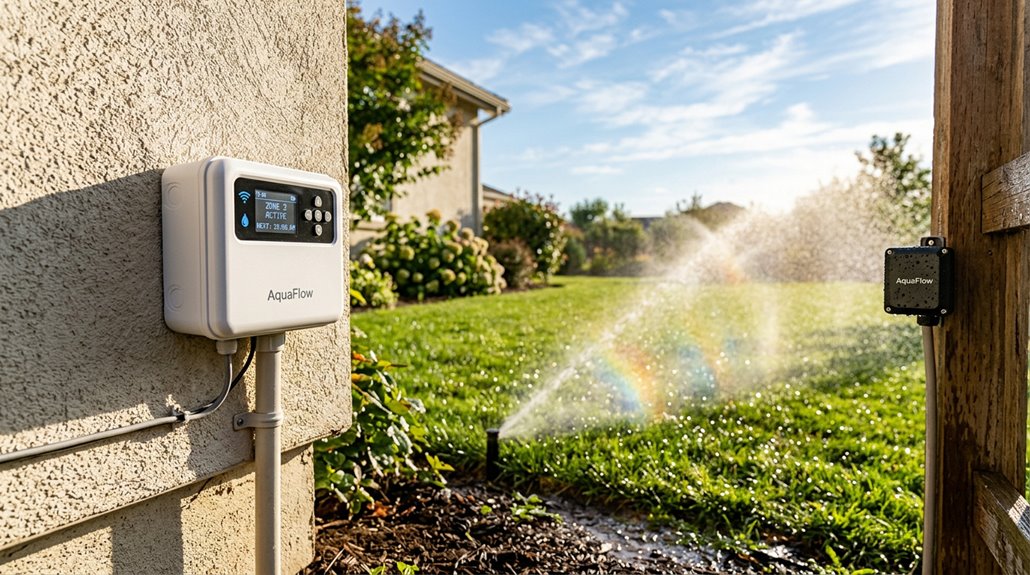
Smart irrigation systems can cut your water usage by up to 50%, and they do it by combining soil moisture sensors, real-time weather data, and customizable zone scheduling so your lawn and garden get exactly what they need — no more, no less.
Controllers like the Orbit B-hyve XR Smart 8-Zone let you manage up to 16 zones from your phone, automatically adjusting watering schedules based on conditions and preventing the all-too-common sin of overwatering.
And once you’ve set your zones and schedules, the system fundamentally runs itself, freeing you from dragging hoses around while quietly keeping your plants healthier than manual watering ever could. Additionally, smart controllers offer significant benefits over manual timers, such as enhanced efficiency and convenience.
How Automated Watering Systems Work
Automated watering systems take the guesswork out of keeping your garden healthy by combining soil moisture sensors, weather data, and app-based controls into one seamless setup.
Here’s how they actually work:
- Soil sensors measure moisture levels and trigger watering only when needed.
- Weather integration skips scheduled cycles if rain is coming.
- App controls let you adjust timing and duration remotely.
Your system checks conditions, decides what’s necessary, and acts accordingly. No babysitting required.
Most smart controllers, like the Orbit B-hyve, support multiple zones and install within an hour.
You get healthier plants and up to 50% less water wasted.
Best Smart Sprinkler Controllers Compared
Choosing the right smart sprinkler controller can feel overwhelming, but a few standout options make the decision easier. You’ll want to compare features before committing your money and your lawn’s health to one system.
| Controller | Key Feature |
|---|---|
| Rachio 3 | 16-zone weather intelligence |
| Orbit B-hyve XR | Covers 16 zones, $125.99 |
| RainBird ST8I | Professional-grade scheduling |
| Hunter Hydrawise | Remote team access |
| Netro Sprite | Budget-friendly AI watering |
Each option connects to Wi-Fi and adjusts automatically based on weather data. And that means you’re never wasting water unnecessarily!
Zoning and Scheduling for Water Conservation
Once you’ve picked your controller, the real magic happens in how you set it up — specifically, how you divide your yard into zones and build a watering schedule that actually makes sense for what you’re growing.
Zones let you treat each area individually. Your drought-tolerant succulents shouldn’t drink like your vegetable beds. Most controllers support 6–16 zones.
Smart scheduling takes it further by factoring in:
- Soil type — clay holds water longer than sandy soil
- Sun exposure — shaded zones need less frequent watering
- Weather data — rain forecasts automatically pause your schedule
You’re in control. Use it.
Smart Plant Monitors and Soil pH Sensors
Once you’ve got your irrigation dialed in, it’s time to get up close and personal with what’s actually happening beneath the surface — and smart plant monitors and soil pH sensors make that surprisingly easy.
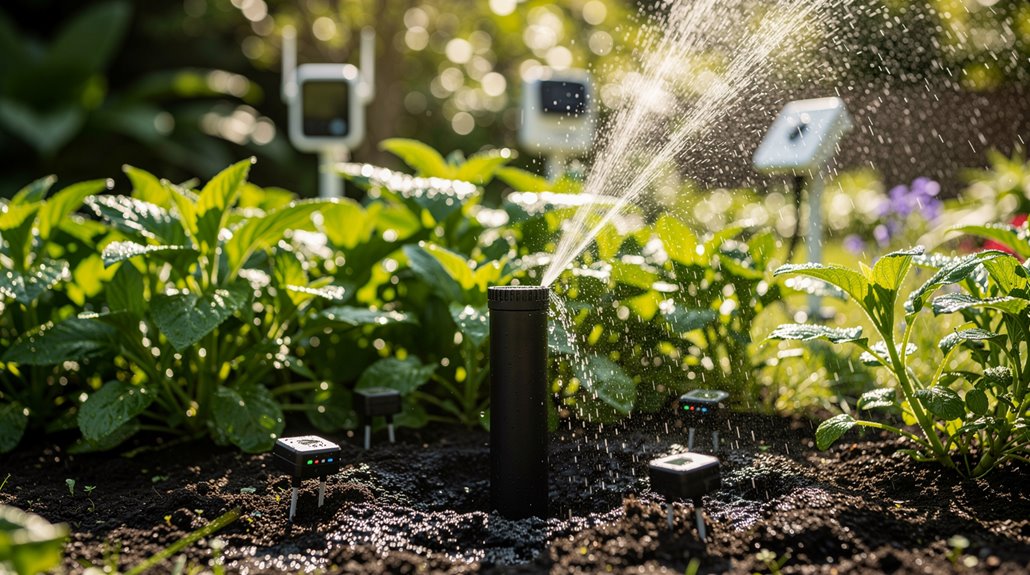
These compact devices push directly into your soil and track conditions like moisture levels, pH balance, nutrient concentration, and temperature in real time, sending that data straight to your smartphone.
And whether you’re working with raised beds, container gardens, or in-ground planting areas, placement matters — a sensor shoved into the corner of a pot won’t give you an accurate read, so aim for the root zone, roughly 2–3 inches deep and centered in the growing medium. Additionally, integrating smart composting technology can enhance soil health by recycling organic materials and providing essential nutrients.
How Smart Plant Sensors Track Soil Conditions
Smart plant monitors and soil pH sensors take the guesswork out of gardening by giving you real-time data on exactly what’s happening beneath the surface.
These devices track critical conditions, including:
- Soil moisture — so you water only when needed
- pH levels — ideally between 6.0–7.0 for most plants
- Temperature and nutrient concentrations
Data syncs directly to your smartphone, alerting you before problems escalate.
And because sensors update continuously, you’re catching deficiencies early — not after your tomatoes stage a protest.
Plant smarter, not harder. Your garden runs better when it’s actually informed.
Comparing Soil pH and Nutrient Sensor Accuracy
Knowing what your soil needs is one thing — knowing whether your sensor is actually telling you the truth is another. Not all soil sensors are created equal, and accuracy varies wildly.
Here’s what separates reliable sensors from fancy dirt sticks:
- pH range: Quality sensors read 3.5–9.0 accurately
- Nutrient detection: Look for NPK (nitrogen, phosphorus, potassium) specificity
- Calibration frequency: Better sensors need recalibration every 30–60 days
Budget sensors often drift ±1.5 pH units. That’s not a small error — that’s the difference between thriving tomatoes and confused, struggling plants.
Invest wisely!
Placement Tips for Pots Beds and Container Gardens
Where you place your soil sensor matters just as much as which one you buy — stick it in the wrong spot and you’re getting a reading that’s about as useful as checking the weather by looking at your ceiling.
Follow these placement tips:
- Pots: Insert sensors 2–3 inches deep, away from container walls.
- Raised beds: Place centrally, 4 inches deep near root zones.
- Containers: Avoid edges — soil dries faster there.
Rotate sensor positions seasonally.
And always keep sensors shaded from direct sun to prevent false temperature readings!
Robotic Lawn Mowers and Smart Mowers
You’ll generally choose between two navigation systems: traditional boundary wire models, which use a buried perimeter wire to define the mowing area, and newer wire-free RTK GPS models, which use satellite positioning accurate to within a few centimeters, no digging required.
And thanks to machine learning, modern mowers continuously map your yard, adapt to irregular terrain, and optimize mowing patterns over time — getting smarter and more efficient with every single pass. RTK GPS technology is revolutionizing the way we approach lawn care, ensuring precise mowing with minimal intervention.
Key Features of Robotic Lawn Mowers
Modern robotic lawn mowers have come a long way from their clunky early iterations, and today’s models pack some genuinely impressive features into a compact, autonomous package.
Here’s what you’ll typically find:
- GPS navigation for precise boundary mapping
- Rain sensors that pause mowing automatically
- App-based scheduling so you’re never tied to a mowing timetable
- Quiet motors running under 60 decibels
- Anti-theft PIN locks and tilt sensors
And most models handle slopes up to 35 degrees.
You get a consistently cut lawn without lifting a finger — freedom rarely looks this tidy!
Boundary Wire vs Wire Free RTK GPS Models
Wire-free RTK GPS models are the upgrade you didn’t know you needed. They use satellite positioning with centimeter-level accuracy, so:
- No digging required
- Easily handles complex lawn shapes
- Simple boundary adjustments via app
But freedom costs more. RTK models typically run $1,500–$3,000+.
If you’ve got a large, oddly shaped lawn, that investment makes total sense.
How Machine Learning Improves Mower Navigation
Early robotic mowers relied on simple randomized bounce patterns to cover your lawn — effective enough, but about as sophisticated as a Roomba with grass anxiety.
Today’s machine learning models change everything. Your mower now builds a spatial memory of your yard, recognizing obstacles, slope variations, and narrow corridors it navigated yesterday. It adapts continuously, optimizing coverage routes over time.
And because it’s learning *your* specific lawn — not a generic template — efficiency improves with every session. The result? Less missed patches, fewer redundant passes, and a mower that genuinely gets smarter the longer you own it.
Smart Weather Stations and Air Quality
A smart weather station does more than just tell you if it’s raining — it tracks temperature, humidity, wind speed, UV index, and barometric pressure in real time, giving you hyperlocal data that a national forecast simply can’t match.
And when you sync that data with your smart irrigation system, you’re letting the technology make smart calls, like skipping a watering cycle when rain is imminent or adjusting schedules during a heat spike.
Some stations also pair with air quality sensors that monitor particulate matter, pollen levels, and CO₂ concentration, so you’ll know exactly when conditions favor — or threaten — your plants. Additionally, smart outdoor lighting solutions can enhance your garden’s ambiance while ensuring safety and visibility during evening hours.
Benefits of a Smart Weather Station for Gardeners
Smart weather stations are one of those garden tools that, once you’ve used one, you’ll wonder how you ever managed without. They give you real-time data that actually matters:
- Temperature and humidity trends affecting plant stress
- Rainfall totals so you’re not watering after a downpour
- Wind speed warnings before delicate plants get battered
- UV index readings for sun-sensitive varieties
And here’s the real freedom — your irrigation system syncs with this data automatically.
No more guessing. No more stepping outside to check clouds. Your garden runs smarter while you do literally anything else.
Air Quality Sensor Capabilities
Beyond tracking rainfall and wind, many smart weather stations now bundle in air quality sensors — and that’s where things get genuinely interesting for gardeners.
These sensors detect:
- PM2.5 and PM10 particulate matter
- CO₂ levels
- UV index readings
- Humidity and pollen indicators
Why does this matter? Poor air quality stresses plants, slows photosynthesis, and affects your own comfort outdoors.
Knowing your UV index helps you schedule delicate transplanting during gentler morning hours.
And elevated CO₂ readings near composting areas? That’s actually useful data.
You’re fundamentally getting a complete environmental picture, not just weather snapshots.
Integrating Weather Data with Smart Irrigation
When your weather station feeds real-time data directly into your irrigation controller, something genuinely useful happens — your garden stops getting watered during a rainstorm.
Smart irrigation systems integrate live weather feeds to automatically skip or delay scheduled cycles based on:
- Rainfall totals
- Humidity levels
- Wind speed and evapotranspiration rates
Your controller calculates actual plant water demand instead of just following a fixed timer.
And that shift saves serious water — up to 50% compared to traditional systems.
Set your rain threshold around 0.25 inches, and your system handles the rest.
Less waste, healthier roots, zero babysitting.
Connectivity Wi Fi Hubs and Smart Devices
When it comes to connecting your outdoor garden devices, you’ve got two main options: Wi-Fi and Bluetooth, and each has its strengths — Wi-Fi handles longer ranges and syncs seamlessly with central hubs, while Bluetooth works best for close-range, low-power devices like soil sensors within 30 feet of your phone.
Most smart garden setups let you manage everything through a single app, and if your device supports it, voice control through Amazon Alexa or Google Home makes adjusting your irrigation schedule or checking air quality as easy as asking out loud.
Additionally, using weatherproof smart plugs can enhance your automation by allowing you to control outdoor appliances remotely.
But if your backyard stretches beyond your router’s reach, a Wi-Fi extender or a mesh network node placed near your garden can push your signal out another 100–150 feet, keeping every smart device reliably connected.
Comparing Wi Fi and Bluetooth for Outdoor Use
Choosing the right wireless protocol for your outdoor smart garden setup can make or break the whole experience, so it’s worth understanding how Wi-Fi and Bluetooth actually differ before you buy anything.
- Wi-Fi: Longer range (up to 300 feet), ideal for irrigation controllers, cameras, and mowers.
- Bluetooth: Short range (30 feet max), better for handheld sensors and portable tools.
Wi-Fi integrates seamlessly with smart home hubs and apps.
Bluetooth conserves battery life beautifully.
But for sprawling gardens, Wi-Fi wins hands down.
Choose based on your garden’s size and your need for remote control freedom.
Using Voice Control and a Central App
Once you’ve sorted out your wireless protocol, the next step is bringing everything together under one roof — or rather, one app.
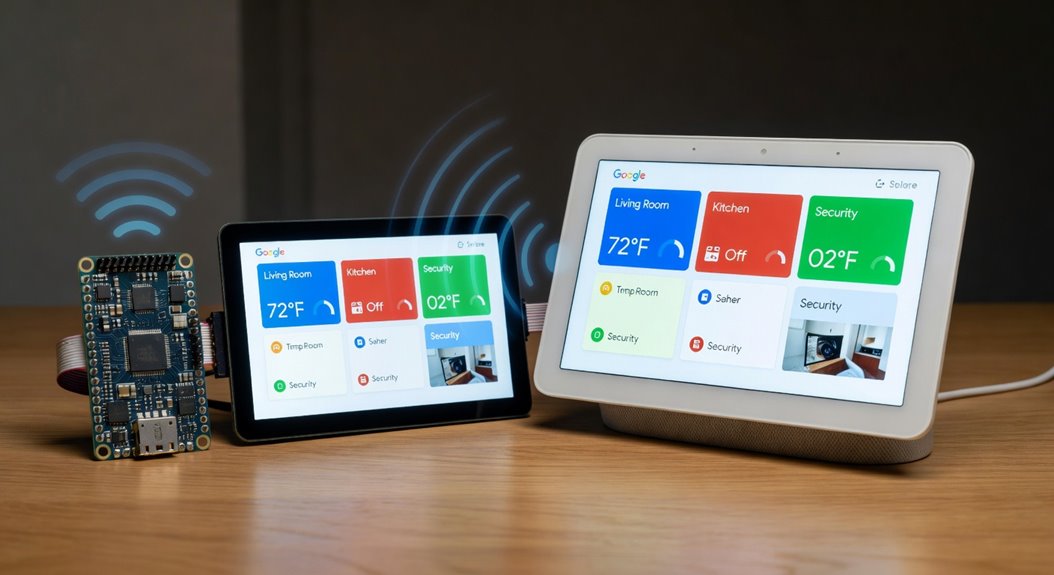
Platforms like Google Home, Amazon Alexa, or Apple HomeKit let you control your smart sprinklers, outdoor lights, and robotic mower from one dashboard. Voice commands make it even easier — just say “water the raised beds” and done.
You’re free to manage everything without hunting through five separate apps. Look for devices labeled “Works with Alexa” or “Matter-compatible” to guarantee smooth integration.
Centralized control isn’t just convenient; it’s genuinely liberating.
Extending Signal Range to Your Backyard
Centralizing your controls in one app is satisfying — right up until you realize your backyard sits just far enough from your router to make your smart sprinkler drop its connection mid-cycle.
Frustrating, but fixable. Extend your signal with:
- A mesh network system (like Eero or Google Nest) — adds nodes that blanket your yard
- A weatherproof Wi-Fi extender — place it near an exterior outlet
- Powerline adapters — run signal through your home’s wiring
Aim for at least -70 dBm signal strength outdoors.
Stronger signal means fewer dropped commands and happier plants!
Choosing the Best Smart Garden Systems
Choosing the right smart garden system means matching your specific needs — soil type, garden size, water access — to the right technology, and not just buying whatever looks flashiest on the shelf. You’ll want to weigh evaluation criteria like weather resistance, app usability, and compatibility with your existing smart home setup before committing. And once you’ve nailed down what matters most, comparing price versus performance across garden types makes the decision a whole lot clearer. Additionally, incorporating smart bird feeders can enhance your overall outdoor experience by attracting a variety of wildlife.
| Garden Type | Recommended System | Price vs. Performance |
|---|---|---|
| Small Container/Patio | Smart plug + soil moisture sensor | Low cost, high convenience |
| Mid-Size Lawn & Beds | Smart sprinkler (e.g., Orbit B-hyve) + robotic mower | Mid-range investment, strong ROI |
| Large Landscape/Edible Garden | AI soil sensors + automated nutrient delivery + weather integration | Higher cost, maximum precision |
| Urban Vertical/Indoor-Outdoor | Connected vertical garden system + app-managed lighting | Moderate cost, space-efficient |
Evaluation Criteria for Smart Garden Purchases
- Weather resistance: Look for waterproof ratings suited to your climate. An IP55 rating handles rain and dust, but harsher environments need higher protection.
- Compatibility: Confirm devices sync with your existing smart home hub or app ecosystem.
- Power options: Decide between wired reliability and wireless freedom.
- Ease of use: Intuitive apps save frustration, and you’ll actually use what’s simple.
- Subscription costs: Some advanced features hide behind paywalls—factor that into your budget.
- Durability: Outdoor gear takes a beating, so rugged construction matters.
Choose tools that fit your lifestyle, not just your wishlist!
Recommendations by Garden Type
Once you’ve nailed down your evaluation criteria, the next step is matching the right tools to your specific garden setup—because a rooftop container garden and a sprawling suburban lawn have very different needs.
- Container/balcony gardens: Smart plugs, soil moisture sensors, app-controlled drip systems
- Suburban lawns: Robotic mowers like the Worx Landroid, multi-zone smart sprinklers covering 8–16 zones
- Vegetable gardens: AI plant-diagnostic apps, precision nutrient delivery systems
- Smart greenhouses: Automated climate controllers managing humidity and temperature
Know your space. Then choose tools that actually fit it!
Price vs Performance Checklist
Smart garden tech spans a surprisingly wide price range—from a $25 smart plug to a $700 robotic mower—so knowing what you’re actually getting for your money before you buy saves you from expensive regret.
Use this quick checklist:
- Under $50: Smart plugs, basic timers—solid automation entry points
- $100–$200: Multi-zone smart irrigation; real water savings, real ROI
- $500–$700: Robotic mowers; premium convenience, significant labor reduction
Ask yourself three things:
- Does it integrate with your existing smart home system?
- Are subscriptions required for full functionality?
- Does weather-resistance match your climate?
Buy smarter, not pricier.
Installation and Integration Tips
Once you’ve chosen your smart garden system, it’s time to get everything up and running — and a solid installation checklist will save you from a frustrating afternoon of troubleshooting.
Start by mapping your irrigation zones and mower boundaries carefully, since accurate zone planning guarantees your system waters the right areas at the right times without wasting a drop or sending your robotic mower into the flower beds. Additionally, consider selecting a robot mower that is designed specifically for small yard optimization, as this can enhance efficiency and performance in limited spaces.
And don’t skip the weatherproofing step — sealing connections, checking IP ratings on outdoor devices, and securing wiring against moisture are small efforts that protect a significant investment.
Step by Step Installation Checklist
Getting your smart outdoor garden system up and running takes a bit of planning, but breaking it down into clear stages makes the whole process manageable — and honestly, kind of satisfying.
Follow this core sequence:
- Map your garden zones and mark sensor placement spots.
- Connect soil moisture sensors and test Wi-Fi signal strength outdoors.
- Sync your irrigation controller, app, and weather integration settings.
Once everything’s linked, run a manual cycle to confirm each zone responds correctly.
Adjust scheduling based on your soil readings.
You’re now running a smarter, more independent garden — no guesswork required.
Zone Mapping for Irrigation and Mowers
Zone mapping is the foundation of a well-integrated smart garden system — get it right, and everything else clicks into place.
Start by sketching your yard’s layout, marking distinct areas like flower beds, lawn sections, and pathways.
Then assign irrigation zones based on:
- Sun exposure (full sun vs. shade)
- Plant water needs
- Soil type
For robotic mowers, define boundary perimeters using guide wires or GPS coordinates.
Most apps let you create virtual zones within minutes.
And overlapping your mower zones with irrigation zones? That’s where efficiency really compounds. Your system works smarter, not harder.
Weatherproofing and Safety Measures
Since your smart garden devices live outdoors year-round, weatherproofing isn’t optional — it’s the difference between a system that thrives and one that shorts out after the first rainstorm.
Check every device’s IP rating before installing it. IP65 handles water jets; IP67 survives submersion up to one meter.
Follow these protective steps:
- Seal conduit entry points with weatherproof silicone
- Mount controllers under eaves or inside lockboxes
- Use UV-resistant cable ties — standard plastic cracks within one season
And always connect devices through a GFCI outlet. It automatically cuts power during moisture exposure, protecting both your equipment and you.
Data Privacy and Machine Learning in Smart Gardening
As your garden gets smarter, machine learning algorithms quietly study your soil moisture patterns, weather history, and plant behavior to automate watering schedules and flag nutrient deficiencies before they become visible problems. Additionally, smart devices like smart water monitors can enhance your garden’s health by providing real-time chemical level data. But that convenience comes with a trade-off — outdoor cameras and connected sensors are constantly collecting data, so you’ll want to review your device’s privacy settings, enable two-factor authentication, and confirm whether your data is stored locally or on a third-party cloud server. And don’t skip regular data backups; most smart gardening platforms let you export your historical sensor data as CSV files, which is worth doing monthly so you’re never locked out of your own garden’s performance record.
How Machine Learning Automates Your Garden
Machine learning is quietly doing some heavy lifting in your garden — and it’s more impressive than it sounds.
It learns your garden’s patterns over time, then acts on them automatically. No micromanaging required.
Here’s what it’s actually doing behind the scenes:
- Adjusting watering schedules based on soil moisture readings and forecast data
- Flagging disease symptoms from plant images before visible damage spreads
- Predicting pest activity using historical and environmental data
- Optimizing fertilization timing by tracking nutrient absorption trends
And the more data it collects, the sharper its decisions become.
Your garden fundamentally trains its own caretaker.
Data Privacy and Security for Outdoor Cameras
When your outdoor cameras are feeding data to machine learning systems, they’re doing a lot more than recording footage — they’re continuously collecting, processing, and transmitting information about your property, your routines, and potentially your neighbors.
That’s worth taking seriously. Protect yourself by:
- Enabling end-to-end encryption on your camera’s app settings
- Using strong, unique passwords — no “garden123”
- Reviewing data-sharing policies before purchasing
- Keeping firmware updated to patch vulnerabilities
And check whether your camera stores footage locally or in the cloud.
Local storage means *you* own your data. That’s real freedom.
Data Backup and Export Best Practices
Your smart garden is quietly generating a surprising amount of data — soil readings, watering logs, pest alerts, growth timelines — and losing it to a system crash or app migration is more painful than it sounds.
Own your data before it owns you.
Do this regularly:
- Export CSV logs monthly from your app’s settings panel
- Back up to cloud storage (Google Drive, Dropbox) automatically
- Screenshot seasonal summaries before subscription lapses
And check whether your platform supports API access — that’s your escape hatch if the company folds.
Your garden’s history is genuinely irreplaceable!
Maintenance and Troubleshooting for Smart Devices
Keeping your smart garden devices running smoothly doesn’t have to be complicated, but it does require a little consistent attention. Start with these three essential maintenance habits:
- Clean sensors and camera lenses monthly to prevent dirt buildup from skewing readings or reducing video clarity.
- Check firmware updates every 4–6 weeks, since manufacturers regularly push patches that fix bugs and improve performance.
- Inspect battery levels on wireless devices like soil sensors and robotic mowers before peak growing season hits.
And when something goes wrong — say, your irrigation controller stops syncing with its app — your first troubleshooting move should always be a hard reset, followed by reconnecting the device to your Wi-Fi network.
This is because roughly 80% of common connectivity issues resolve that simply.
Routine Maintenance Tasks and Schedules
Staying on top of routine maintenance keeps your smart outdoor garden devices running smoothly and extends their lifespan considerably. Set a simple schedule:
Weekly:
- Clear debris from sensors and camera lenses
- Check soil moisture probe calibration
Monthly:
- Update firmware on connected devices
- Inspect weatherproof seals for cracks
Seasonally:
- Replace batteries in wireless sensors
- Recalibrate irrigation zones based on seasonal plant needs
And don’t skip software updates — they often patch security vulnerabilities and improve performance.
Clean smart sprinkler heads quarterly to prevent mineral buildup. Your devices work hard; give them occasional attention, and they’ll return the favor reliably.
Common Troubleshooting Steps
Even with a solid maintenance routine in place, things will occasionally go sideways — a sensor stops responding, an app loses connection, or your irrigation system decides to water the lawn at 2 a.m. for no apparent reason.
Don’t panic. Try these steps first:
- Restart the device — solves roughly 80% of issues instantly.
- Check Wi-Fi signal strength near the device.
- Reinstall the app if connectivity persists.
- Reset soil sensors and recalibrate moisture thresholds.
And if nothing works? Contact manufacturer support — most smart garden brands offer solid troubleshooting resources.
Firmware Updates and Battery Care
Battery Care:
- Recharge before levels drop below 20%
- Store devices indoors during freezing temps
- Clean battery contacts quarterly
And yes, a dead battery mid-growing season is exactly as frustrating as it sounds.
Stay proactive, and your smart garden keeps working hard for you.
Budgeting ROI and Best Smart Buys
Smart outdoor garden tech doesn’t have to break the bank, but knowing where to spend versus where to save makes all the difference. Devices like the Kasa Outdoor Smart Plug (under $25) deliver solid ROI almost immediately, while higher-ticket items like the Worx Landroid S ($699.99) pay off gradually through reduced labor and water savings of up to 50%. Before you buy anything, always check warranty length, app support commitments, and replacement part availability — because a “smart” device with zero manufacturer support is just an expensive paperweight.
| Budget Tier | Recommended Device | Estimated ROI Timeline |
|---|---|---|
| Under $50 | Kasa Outdoor Smart Plug | Immediate |
| $100–$200 | Orbit B-hyve XR Smart 8-Zone Sprinkler | 6–12 months |
| $500–$800 | Worx Landroid S Robotic Mower | 18–24 months |
Upfront Costs vs Long Term Savings
How much does it actually cost to go smart with your outdoor garden — and is it worth it? Entry-level devices like the Kasa Outdoor Smart Plug run under $25, while premium setups like the Weber Genesis II EX-335 hit $1,049.
But here’s the payoff: smart irrigation alone cuts water usage by up to 50%, trimming utility bills greatly over time. You’re trading upfront investment for long-term freedom — less labor, fewer wasted resources, and healthier plants.
And robotic mowers like the Worx Landroid S reduce maintenance costs steadily. Smart spending now genuinely pays you back later.
Best Smart Devices by Budget Tier
Whether you’re dipping your toes in or ready to go all-in, there’s a smart garden device for every budget — and knowing where to spend matters more than spending a lot.
- Under $25: Kasa Outdoor Smart Plug — automate lights or pumps instantly
- Under $130: Orbit B-hyve 8-Zone Smart Sprinkler — cuts water waste considerably
- Under $700: Worx Landroid S Robotic Mower — reclaims your weekends
Start small. One smart plug reveals how automation fits your lifestyle before you commit further.
Then scale up strategically. Your garden, your pace, your rules.
Warranty and Support Checklist
- Return window: 30 days minimum
- Tech support access: Phone, chat, or email—ideally all three
- Firmware updates: Free and ongoing
- Replacement parts: Actually available, not discontinued six months post-launch
And don’t overlook user communities.
Active forums mean real troubleshooting help when your smart irrigation controller decides 3 a.m. is watering time.
Strong warranty terms protect your investment; strong support ecosystems protect your sanity!
Future Trends in Smart Gardening
The future of smart gardening is moving fast, and machine learning is leading the charge — AI systems are getting sharper at predicting plant diseases, nutrient deficiencies, and watering needs before you even notice a problem.
Robots and drones are stepping up too, handling everything from targeted weed removal to aerial crop monitoring with a precision that would make even the most dedicated gardener a little envious.
And here’s the really exciting part: as the technology matures, prices are dropping, meaning the smart garden tools that once felt like a luxury are quickly becoming as affordable and accessible as a basic garden hose.
Machine Learning and AI Advancements
As smart gardening tech keeps evolving, machine learning and AI are quickly becoming the backbone of how your garden thinks, adapts, and even anticipates problems before they happen.
These systems learn your garden’s patterns over time, getting smarter with every season.
Here’s what AI currently handles:
- Disease detection from smartphone images
- Predictive pest alerts before infestations spread
- Nutrient deficiency forecasting based on soil data trends
And the best part? Your system stops reacting and starts *predicting*.
That’s less guesswork, fewer chemicals, and more control — entirely on your terms.
Robotic and Drone Garden Integrations
Robotic and drone integrations are pushing smart gardening into territory that would’ve sounded like science fiction just a decade ago.
Robotic mowers like the Worx Landroid navigate your yard autonomously, using GPS boundaries and weather-adjusted schedules. Drones take it further — they’ll survey large garden plots, identify pest hotspots, and even deliver targeted pesticide applications with precision.
You’re not just saving time; you’re eliminating guesswork entirely.
Key capabilities include:
- Autonomous mowing with obstacle detection
- Aerial crop monitoring via multispectral imaging
- Precision spraying within centimeter-level accuracy
And honestly? Your garden’s never been in better hands — even robotic ones.
Affordability and Accessibility Predictions
All that drone-surveying and robotic mowing sounds impressive — and it’s — but you’re probably wondering what it costs to actually get there.
Good news: prices are dropping fast. Smart plugs run under $25, soil sensors under $50, and basic smart irrigation controllers like the Orbit B-hyve start around $125.
As competition grows, expect:
- Entry-level automation under $100
- Modular systems you expand gradually
- Subscription-free options increasing yearly
You don’t need everything at once. Start with one device, learn it, then build outward.
Accessibility is catching up to ambition — and your garden’s independence is closer than you think.
Conclusion
You’ve got the tools, the knowledge, and zero excuses now. Smart gardening isn’t just for tech enthusiasts — it’s for anyone who wants healthier plants, lower water bills, and fewer weekends spent troubleshooting dying tomatoes. Start small with one smart device, learn its quirks, then expand. Your garden’s basically waiting for you to stop reading and start installing. And honestly? Your plants have been patient long enough!