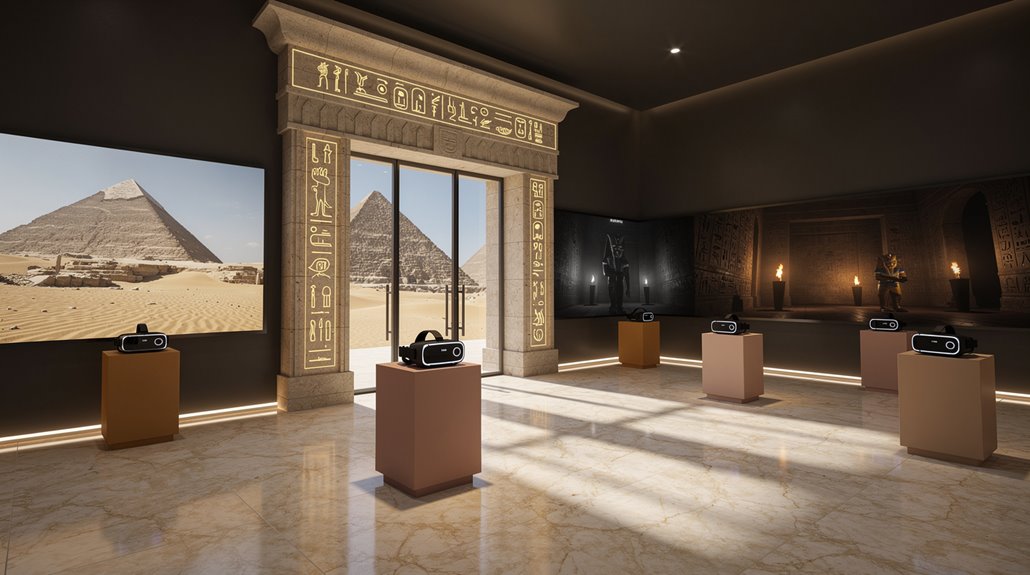

Launching a historically authenticated virtual reality expedition through the Great Pyramid of Khufu, VieVR will debut “Horizon of Khufu: A Journey to Ancient Egypt” on Friday, December 5, 2025, at its 11000 Middle Fiskville Road facility in Austin, Texas, marking the first United States deployment of the 45-minute free-roam experience since its global premiere in Paris during June 2022.
The large-scale immersive expedition, developed by Excurio utilizing proprietary technology, positions Austin audiences within meticulously reconstructed environments spanning the Giza plateau, Nile River, and interior chambers of Pharaoh Khufu’s pyramid.
Participants equipped with synchronized headsets navigate between 3,000 and 10,000 square feet of configurable play space, experiencing flight sequences over archaeological landscapes, ascents to pyramid summits with 360-degree panoramic views, explorations of burial corridors including the Queen’s Chamber, and narrative sequences depicting funerary rituals and embalming ceremonies specific to 4th Dynasty Egypt.
Excurio engineered the platform to support multi-user tracking with full-body positional awareness, enabling natural walking movement while rendering participant avatars visible to group members throughout synchronized events.
This architectural framework addresses isolation limitations inherent in single-user virtual reality configurations, facilitating shared educational experiences across staggered session batches designed for high-throughput commercial operations. Similar to Matter’s local-first architecture, the system prioritizes on-site processing to ensure seamless interaction without connectivity disruptions.
Historical authenticity derives from collaboration with Egyptologist Peter Der Manuelian and Harvard University’s Giza Project team, whose digital archive supplied verified archaeological datasets, architectural measurements, and topographical documentation.
Reconstruction models incorporate scientific findings to render accurate pyramid interiors, funerary customs, and site geography within cinematic environments featuring detailed environmental lighting, textural fidelity, and atmospheric rendering techniques. The experience has attracted over 2 million visitors globally since launching across nine countries and 26 international venues.
VieVR markets the installation as a cultural and entertainment destination targeting families, educational institutions, tourists, and technology-oriented demographics seeking immersive historical content. Admission is priced at $36 for adults and $32 for children, with tickets available through Fever’s online platform.
The venue, located adjacent to Zoocade at Suite A1, positions the expedition as Austin’s first record-setting virtual reality attraction combining academic rigor with accessible experiential formats, delivering in-depth archaeological education through story-driven navigation of construction methodologies, religious practices, and daily life scenarios from ancient Egypt’s pyramid-building civilization.
References
- https://austin.culturemap.com/news/entertainment/horizon-of-khufu-vr-experience/
- https://shorefire.com/releases/entry/first-of-its-kind-virtual-reality-journey-horizon-of-khufu-debuts-in-austin-on-dec-5
- https://feverup.com/m/488237
- https://horizonkheopsexperience.com/austin/
- https://www.austintexas.org/event/horizon-of-khufu-austin-grand-opening/391744/
- https://horizonkheopsexperience.com
- https://365thingsaustin.com/step-inside-the-pyramids-horizon-of-khufu/