
SoundTouch end-of-life timeline and policy shift
Original SoundTouch cloud EoL scheduled for 18 February 2026. Later moved to 6 May 2026 after customer backlash.
Bose confirmed end of SoundTouch app and cloud service support in May 2026, while retaining certain local features.
Update in January 2026 announced an automatic app update on 6 May 2026 to enable key local-only functions.
Company decision reframed from total “smart speaker shutdown” to a graceful degradation model preserving core playback and control.
Shifted from a full shutdown to a graceful degradation, preserving core playback and local control for continued use.
EoL communication included a dedicated support page and staged disclosures about what features would survive post-cloud.
Public release and nature of the SoundTouch Web API
Bose published thorough SoundTouch Web API documentation as a freely downloadable 31-page PDF specification.
API documentation describes HTTP-based endpoints over port 8090, using GET and POST for command and control of SoundTouch devices.
Specification includes WebSocket protocols for real-time notifications such as now-playing, presets, recents, and zone updates.
Documentation covers device discovery, source selection, volume, presets, zones, audio DSP, bass and treble, and capabilities queries.
API terms released under a royalty-free but proprietary, revocable license, with no firmware or server source code provided.
Functionality preserved for end users after cloud shutdown
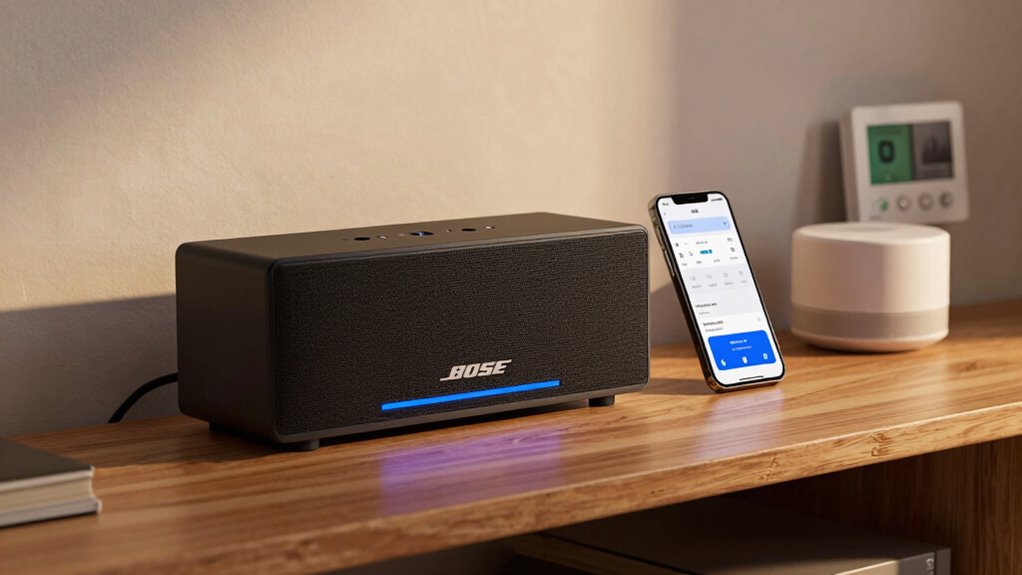
Post-EoL, speakers retain Bluetooth, AUX-in, and local network playback control, avoiding complete “dumb speaker” status.
AirPlay and Spotify Connect functionality confirmed to continue beyond the cloud shutdown, despite earlier uncertainty.
SoundTouch mobile app will continue in a stripped-down, local-only mode with no dependence on Bose cloud servers.
Updated app will still allow setup, configuration, remote control, and grouping for systems on the same Wi-Fi network.
Streaming after 6 May 2026 expected via direct streaming from third-party apps using AirPlay, Bluetooth, AUX, or Spotify Connect.
The transition to local storage solutions mirrors trends seen in security cameras that offer local storage options without subscription fees.
Developer capabilities enabled by the API
API enables third parties to build replacement control apps, dashboards, and integrations that talk directly to speakers on the LAN.
Endpoints such as /key, /select, /volume, /presets, /recents, /now_playing, /zone allow extensive control of playback and grouping.
WebSocket notifications like presetsUpdated, recentsUpdated, nowPlayingUpdated, zoneUpdated support real-time UI updates without polling.
APIs for /bass, /audiodspcontrols, /audioproducttonecontrols expose bass, treble, and DSP tuning where supported by the hardware.
Documentation defines structured types, for example ART_STATUS, BOOL, INT, AUDIO_MODE and XML payload schemas for consistent client implementations.
Licensing, governance, and “open” vs open source debate
API documentation distributed under royalty-free terms, permitting complete Web API access.
This move supports open source model development by enabling community-driven innovation.
References
- https://itsfoss.com/news/bose-soundtouch-api/
- https://www.engadget.com/audio/speakers/bose-made-the-consumer-friendly-move-to-open-source-its-soundtouch-speakers-163459024.html
- https://www.whathifi.com/speakers/wireless-speakers/bose-extends-the-life-of-its-soundtouch-speakers-following-backlash-heres-which-features-will-still-work
- https://assets.bosecreative.com/m/496577402d128874/original/SoundTouch-Web-API.pdf
- https://sixcolors.com/link/2026/01/bose-open-sources-discontinued-speaker-api/
- https://www.bose.com/soundtouch-end-of-life