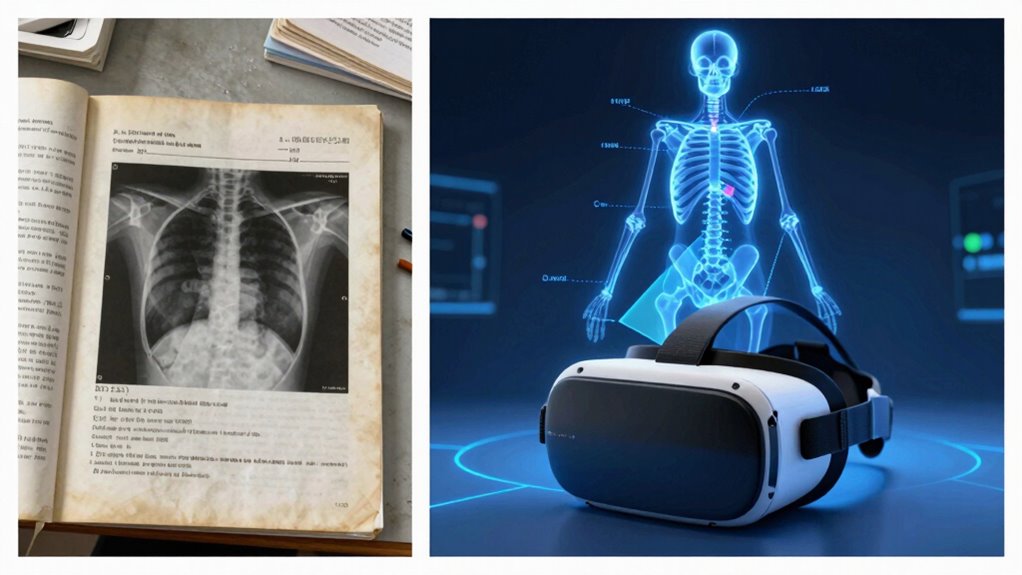
While you’re probably imagining VR as just gaming headsets and zombies chasing you through abandoned malls, it’s quietly making waves in places you’d never expect—like medical imaging labs. Turns out, strapping on a headset to learn how to position a patient’s arm for an X-ray is way cooler (and way more productive) than blasting pixelated aliens.
VR’s not just for gaming zombies—imagine learning X-ray positioning in medical labs. Turns out, it’s way cooler than blasting pixelated aliens.
Medical students aren’t just playing pretend—they’re diving into immersive learning experiences that actually stick. And when it comes to skill retention, VR’s like that one friend who remembers every embarrassing thing you did in middle school—relentless in a good way. Studies show radiology students using VR not only improved their image clarity and equipment handling but also kept those skills sharp eight months later. Yeah, eight months—longer than most New Year’s resolutions last.
It’s not just about remembering what button does what. VR-trained students crushed it in areas like beam alignment, marker placement, and exposure settings. Even those who struggled with visual-spatial skills—the folks who still get lost in IKEA—showed major gains. How? Because VR gives instant feedback, like a GPS for radiography, telling you, “No, buddy, tilt the machine five degrees left.”
And students aren’t faking enthusiasm. Ninety-one percent said VR could actually help in radiology education—higher than the percentage who say they love pizza (okay, maybe not that high, but close). They also found it freakishly realistic—90% said the equipment in VR felt like the real thing. Who knew virtual knobs could feel so satisfying?
Performance-wise, more than three-quarters reported better technical skills, and a whopping 88% felt sharper at evaluating their own work. Even problem-solving got a boost. It’s like VR turns rookies into radiology ninjas. As medical education continues to evolve, VR training may become as commonplace as the household robots predicted to enter our homes between 2028 and 2035.
Surprisingly, whether you’re 20 or 50, male or female, a gamer or someone who still uses a flip phone—none of it really matters. VR levels the playing field. And while a few students weren’t totally sold—37% in one study were just “content”—most agreed: this isn’t just tech for tech’s sake. It’s a whole new way to learn, remember, and actually enjoy medical training. VR was the most frequently studied immersive technology in medical education, particularly showing strong results in skill acquisition and performance enhancement. This aligns with broader trends where emerging technologies present significant research opportunities in medical training.
References
- https://pmc.ncbi.nlm.nih.gov/articles/PMC11094427/
- https://www.frontiersin.org/journals/digital-health/articles/10.3389/fdgth.2024.1365345/full
- https://pmc.ncbi.nlm.nih.gov/articles/PMC8851326/
- https://www.aamc.org/news/future-or-fad-virtual-reality-medical-education
- https://onlinelibrary.wiley.com/doi/10.1002/jmrs.868
- https://www.spiedigitallibrary.org/conference-proceedings-of-spie/13411/1341116/Evaluating-the-benefit-of-immersive-virtual-reality-in-training-radiology/10.1117/12.3046834.full