While police departments nationwide continue dispensing 168 hours of weapons training versus a paltry ten hours on mental health intervention—because apparently nothing says “protect and serve” quite like a 17-to-1 ratio favoring shoot-first protocols—criminal justice students are finally getting access to the same virtual reality technology that’s been teaching officers how to maybe, possibly, consider not killing the sixteen-times-more-vulnerable mentally ill civilians they encounter on the street.
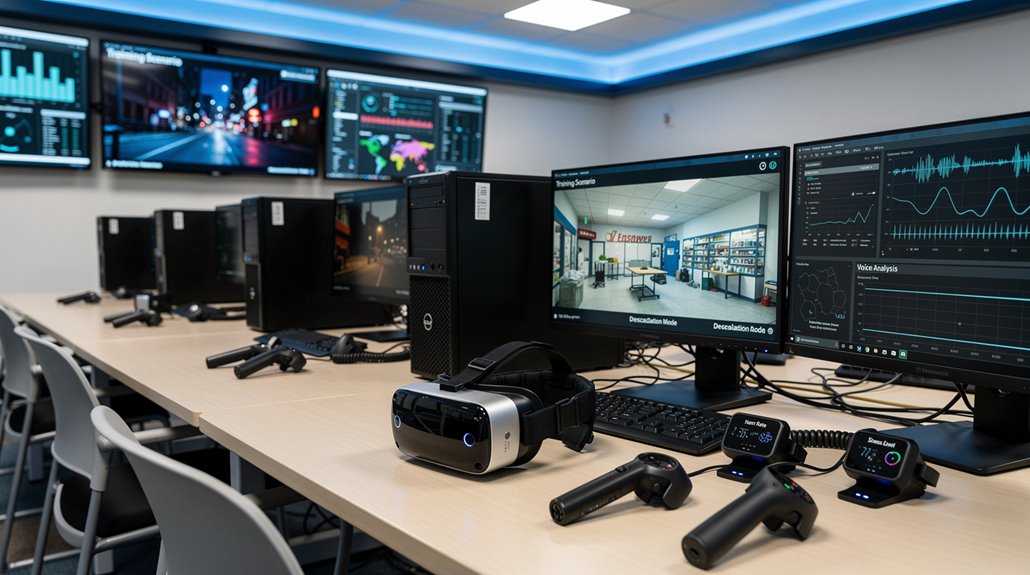
UW-Oshkosh has introduced VR police training to students intending to work in law enforcement, offering fully immersive environments simulating domestic disturbances, active shooter scenarios, and mental health crises. The technology creates controlled settings where future officers can practice radical concepts like communication and empathy without the inconvenient consequence of actual corpses, a rejuvenating departure from traditional methods that treat de-escalation skills as optional garnish on the use-of-force entrée.
Research demonstrates that VR notably increases physiological and subjective stress markers, approximating real-world conditions more effectively than whatever theatrical role-playing exercises currently masquerade as preparation for encounters with the twenty-five percent of mentally ill individuals who report arrest histories and documented excessive force. Officers engaging with VR mental health training environments report moderate to high immersion levels, with sensory engagement and naturalness of interactions serving as key factors—turns out strapping sophisticated technology to someone’s face produces better results than a PowerPoint presentation about not shooting people having psychotic episodes. Florida Atlantic University’s study found that sympathy-related items demonstrated stronger correlations compared to empathy-related items among the forty participating officers, suggesting that virtual environments might trigger compassion even when cognitive perspective-taking falls short.
VR training approximates real stress better than role-playing exercises that somehow pass for preparing officers to not kill mentally ill civilians.
The platforms incorporate eye-tracking, voice analysis, and biometric feedback to evaluate attention, stress, and communication under pressure, while AI-driven systems simulate scenarios evolving based on verbal and physical responses. After-action reviews allow instructors and trainees to deconstruct decisions through reflective practice, generating data analytics that identify skill gaps across departments. Predictive analytics create personalized learning pathways for individual officers, tailoring future training modules to address specific deficiencies that emerge from performance data rather than subjecting everyone to identical remedial exercises designed for the lowest common denominator. Similar to how Alexa devices use voice commands to control smart home environments, these VR systems respond to officer verbal cues to shape realistic training scenarios.
Students experiencing initial confusion or disorientation during VR exercises showed links to greater empathy in subsequent responses, suggesting that momentary technological bewilderment might accomplish what decades of racial justice protests apparently could not.
Whether this represents genuine institutional reform or merely expensive performative absolution remains unclear, though one supposes virtual dead bodies constitute marginal improvement over the traditional curriculum’s actual ones.
References
- https://www.lycoming.edu/news/stories/2022/11/virtual-reality-police-training.aspx
- https://www.fau.edu/newsdesk/articles/police-training-virtual-reality
- https://www.police1.com/police-products/virtual-Reality-training-products/how-immersive-technology-is-advancing-police-training
- https://academic.oup.com/policing/article/doi/10.1093/police/paaf030/8233616
- https://www.policingproject.org/rethinking-response-articles/2025/5/8/part-two-body-worn-camera-analytics-e3zg9-zlhxw
- https://bjs.ojp.gov/document/slletatti22st.pdf
- https://www.inveristraining.com/vr-police-training-revolution/
- https://www.brookings.edu/wp-content/uploads/2021/03/Rashawn-Ray_Congress-Testimony_2-24-21.pdf