For two centuries, Western psychiatry has cycled through a predictable routine: lock up the mad, drug them into compliance, declare victory, then sheepishly admit that maybe—just maybe—talking to people experiencing auditory hallucinations might actually help.
Enter avatar therapy, the digital brainchild of Emeritus Professor Julian Leff at UCL, which operates on the revolutionary premise that patients might benefit from confronting personalized computer-generated representations of the voices tormenting them rather than simply swallowing another antipsychotic and hoping for pharmacological salvation.
Confronting digital demons proves more effective than another prescription—who knew acknowledging patients’ reality might constitute actual treatment?
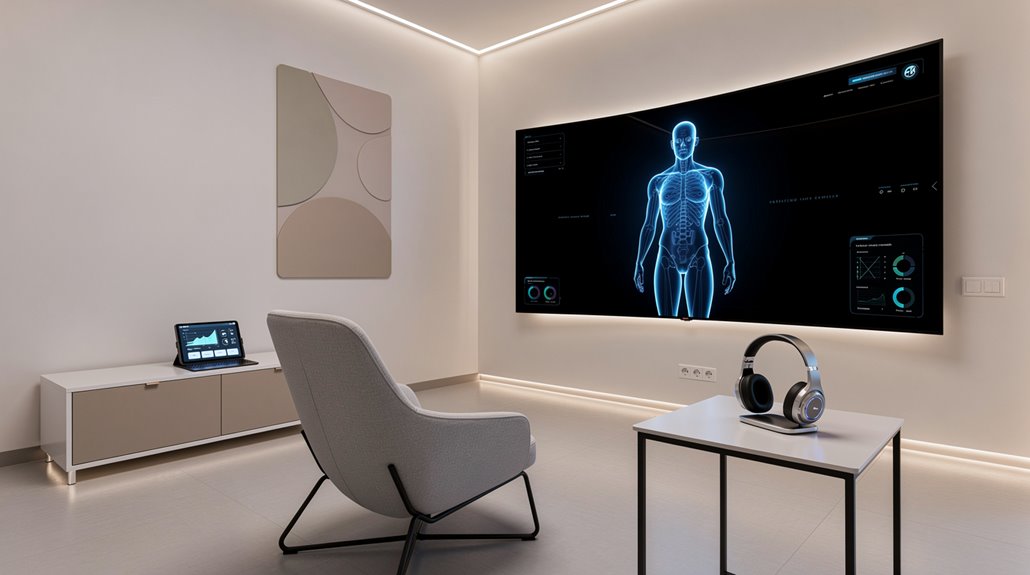
The methodology borders on science fiction meets therapy session: patients collaborate with clinicians to design avatars matching their hallucinations’ appearance and vocal characteristics, then engage in structured three-way conversations where they practice assertiveness against digital demons.
Over six weekly fifty-minute sessions, participants tell their tormentors to kindly shut up while therapists facilitate this technologically mediated exorcism. Patients even receive audio recordings for home use, because apparently homework exists in psychiatric treatment now.
The Maudsley Hospital trial comparing avatar therapy against supportive counselling enrolled 150 schizophrenia patients averaging twenty years of disease duration—long enough to exhaust conventional treatments and patient optimism alike. The trial specifically recruited individuals whose auditory hallucinations had persisted for over a year, ensuring participants represented genuinely treatment-resistant cases.
Results demonstrated markedly reduced hallucination severity in the avatar group, with seven participants reporting complete cessation versus two in the counselling cohort. The effects weren’t fleeting either; improvements sustained through twenty-four-week follow-up, suggesting this wasn’t mere placebo theater.
Subsequent multi-centre research involving 345 participants tested brief versus extended protocols against usual treatment. Both interventions produced statistically significant improvements in voice severity and distress at sixteen weeks, though extended therapy demonstrated stronger, more durable effects at twenty-eight weeks—shocking absolutely nobody who understands that complex psychiatric conditions might require more than six sessions to meaningfully address.
The therapy now has official backing, receiving a NICE recommendation in March 2024 for NHS use while further evidence accumulates.
The irony remains exquisite: after decades of institutionalization, lobotomies, and pharmaceutical monotony, evidence suggests that structured dialogue with computerized hallucinations helps treatment-resistant patients reclaim control.
Western medicine finally discovered that acknowledging patients’ subjective experiences and providing tools for mastery might actually constitute therapy. Revolutionary thinking indeed.
References
- https://www.ucl.ac.uk/news/2017/nov/avatar-therapy-reduce-auditory-hallucinations-people-schizophrenia
- https://www.kcl.ac.uk/news/spotlight/the-power-of-digital-avatars-in-psychosis-therapy
- https://sciencemediacentre.es/en/clinical-trial-tests-digital-avatar-treat-voices-people-psychosis
- https://healthjournalism.org/blog/2024/11/avatar-therapy-could-help-patients-manage-hallucinations/
- https://www.nature.com/articles/s41591-024-03252-8
- https://wellcome.org/insights/articles/avatar-digital-therapy-could-help-people-who-hear-voices