The British Virgin Islands has decided to strap virtual reality headsets onto primary school children—because apparently teaching kids to read, write, and perform basic arithmetic without the aid of a 92-country-tested technological crutch has become too pedestrian for the Ministry of Education, Youth Affairs and Sports.
Because traditional education—books, pencils, and competent instruction—has clearly failed humanity for the past several thousand years.
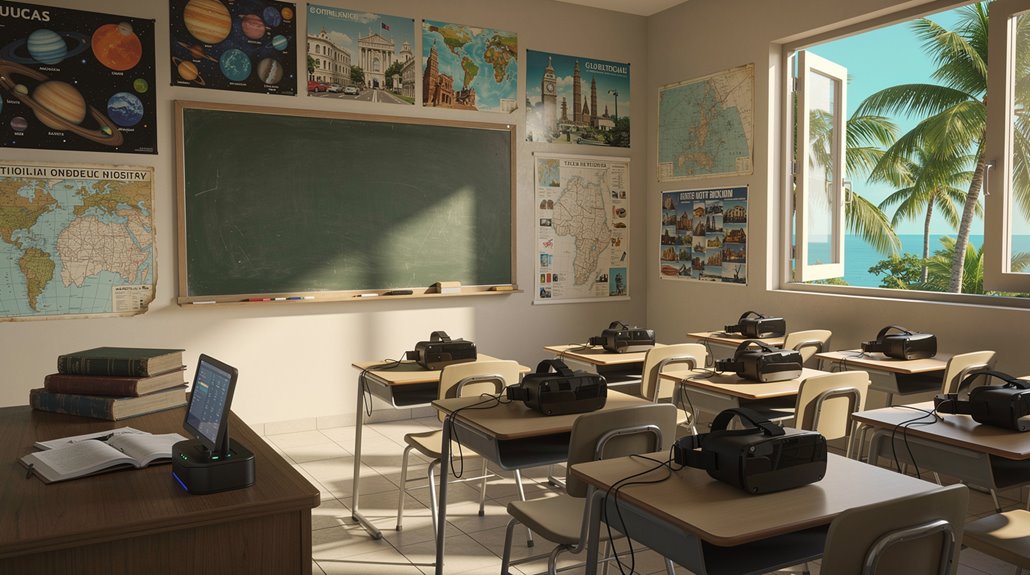
In collaboration with Unite BVI and Avantis Education, the territory has launched a 12-week pilot program that will inflict ClassVR technology upon students aged 5-12, transforming ten schools across the islands into laboratories for what administrators certainly consider pedagogical innovation.
Thirty-two teachers from eight public schools and two private institutions endured a full-day workshop to learn how virtual reality headsets preloaded with curriculum-aligned content will revolutionize education—as if centuries of effective teaching somehow required Silicon Valley’s intervention.
The Ministry’s technical teams have established long-term support infrastructure, committing resources to maintain devices that will inevitably malfunction, break, or become obsolete within eighteen months while textbooks gather dust.
Students will explore global destinations, take virtual tours of planets, and visit Mars without leaving their classrooms, which sounds tremendously enriching until one remembers that previous generations managed to learn geography, astronomy, and science through radical technologies like books, maps, and telescopes.
The platform’s artificial intelligence integration allows children to create custom virtual worlds via prompt input, fundamentally training five-year-olds to become prompt engineers instead of, say, competent readers.
Officials anticipate increased engagement, higher knowledge retention, and improved openness to learning—metrics that conveniently ignore whether students can actually write coherent sentences or solve mathematical problems without technological assistance.
The Virgin Islands proudly positions itself as the first Caribbean nation to adopt ClassVR, a distinction roughly equivalent to being first in line for experimental surgery.
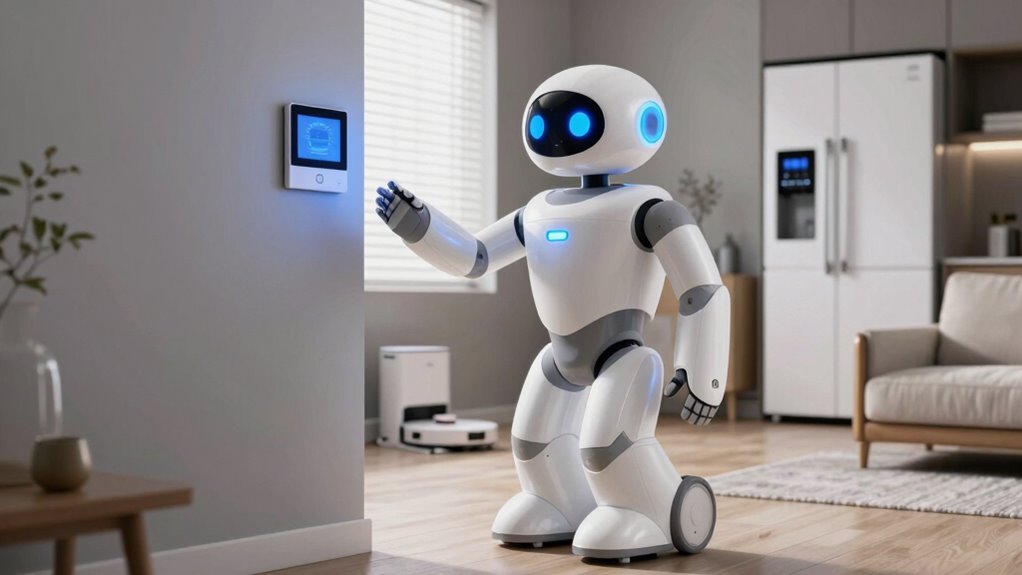
The Ministry’s commitment to preparing students for a technology-driven future demonstrates an admirably forward-thinking approach to education, assuming that future involves children who cannot distinguish between actual experiences and simulated ones. This initiative seems particularly misguided given that by 2030, early adopters will have 3-7 specialized robots in their homes, making these VR headsets likely obsolete before these students even graduate.
Teachers will benefit from ongoing support through both online and in-person sessions, ensuring maximal dependency on external assistance rather than professional autonomy.
Grade five and six teachers received initial training focus, with expansion planned following the pilot’s inevitable declaration of success regardless of measurable outcomes.
This grand experiment coincides with innovation week activities, perfectly timing the deployment of headsets with celebrations of technological progress.
References
- https://www.youtube.com/watch?v=CbNRPnmt3AA
- https://www.edtechinnovationhub.com/news/avantis-education-launches-vr-pilot-program-in-the-caribbean-ahead-of-a-wider-rollout
- https://www.tsbvi.edu/tx-senseabilities/issues/spring-2021/early-intervention-101-a-virtual-reality
- https://dl.acm.org/doi/10.1145/3715335.3735474
- https://papers.ssrn.com/sol3/Delivery.cfm/SSRN_ID4595370_code2960636.pdf?abstractid=4595370&mirid=1
- https://www.viepscor.org/informal-learning