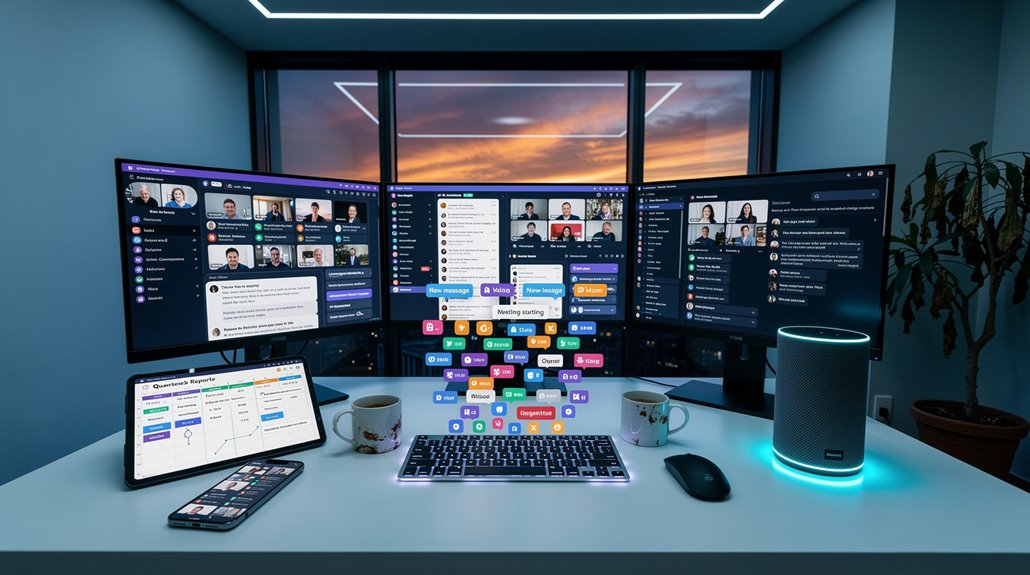

While Microsoft’s latest productivity metrics trumpet a 291% return on investment from Teams implementation, the company’s own data reveals a dystopian hellscape where workers drown in 153 daily messages, sacrifice weekends to PowerPoint decks, and find themselves imprisoned in an “infinite workday” that mockingly extends collaboration into every waking hour.
Microsoft celebrates 291% ROI while workers suffocate under 153 daily messages in an infinite workday masquerading as collaboration.
The corporate euphemism “hybrid work environment” has released a 192% explosion in Teams meetings since February 2020, with 60% occurring as unscheduled ambushes that obliterate any pretense of planning one’s day. Microsoft proudly reports saving workers 7.6 minutes daily through improved call quality, a pittance that evaporates instantly when half of all meetings cluster between 9-11 am and 1-3 pm, precisely when actual productive work might theoretically occur.
Nearly 70% of surveyed workers lack sufficient uninterrupted focus time, yet management celebrates a 17.7% reduction in “time to decision” as though accelerating the pace of institutional dysfunction constitutes progress.
The global collaboration fantasy has birthed genuine horrors: 30% of meetings now span multiple time zones, with after-8pm sessions surging 16% year-over-year. Workers respond predictably by fleeing to weekends, where Word, Excel, and PowerPoint usage overtakes Teams messages as desperate employees seek refuge from the communication firehose. Much like how Echo device hardware relies on Alexa’s software intelligence to function, today’s workers depend entirely on Microsoft’s ecosystem to validate their professional existence.
The 122% spike in PowerPoint edits during the final ten minutes before meetings captures the essence of modern knowledge work—frantic last-minute scrambling masquerading as deliverables. Meanwhile, 62% find excessive time spent searching for information as workers navigate the labyrinth of scattered data across countless channels and threads.
Microsoft’s solution to this chaos they’ve engineered? Immersive events within Teams, because clearly what drowning workers need is more elaborate digital theater. The platform’s 270 million monthly active users remain trapped in an ecosystem where 57% of time goes toward communicating rather than creating, while 450 new features introduced in 2020 alone guarantee the complexity never diminishes. This deluge emerged from a company that witnessed video calls explode by over 1000% in March 2020, permanently rewiring workplace expectations around synchronous presence.
When 58% of workers struggle brainstorming virtually and 55% cannot identify clear next steps after meetings conclude, perhaps the answer isn’t technological innovation but acknowledging that endless synchronous communication destroys rather than enables work.
But such heresy threatens the $35 million net benefit value, so expect more immersive distractions instead.
References
- https://www.notta.ai/en/blog/microsoft-teams-statistics
- https://www.goingconcern.com/microsoft-crunches-some-data-to-find-out-teams-is-the-biggest-productivity-killer-at-work/
- https://blogs.microsoft.com/blog/2022/10/11/microsoft-and-meta-partner-to-deliver-immersive-experiences-for-the-future-of-work-and-play/
- https://www.microsoft.com/en-us/worklab/work-trend-index/breaking-down-infinite-workday
- https://www.microsoft.com/insidetrack/blog/the-future-of-work-is-here-transforming-our-employee-experience-with-ai/
- https://www.microsoft.com/en-us/research/wp-content/uploads/2022/04/Microsoft-New-Future-of-Work-Report-2022.pdf
- https://onediversified.com/insights/blog/microsoft-modern-work
- https://pulse.microsoft.com/en/work-productivity-en/na/fa1-new-report-shares-insights-into-making-remote-meetings-more-productive/