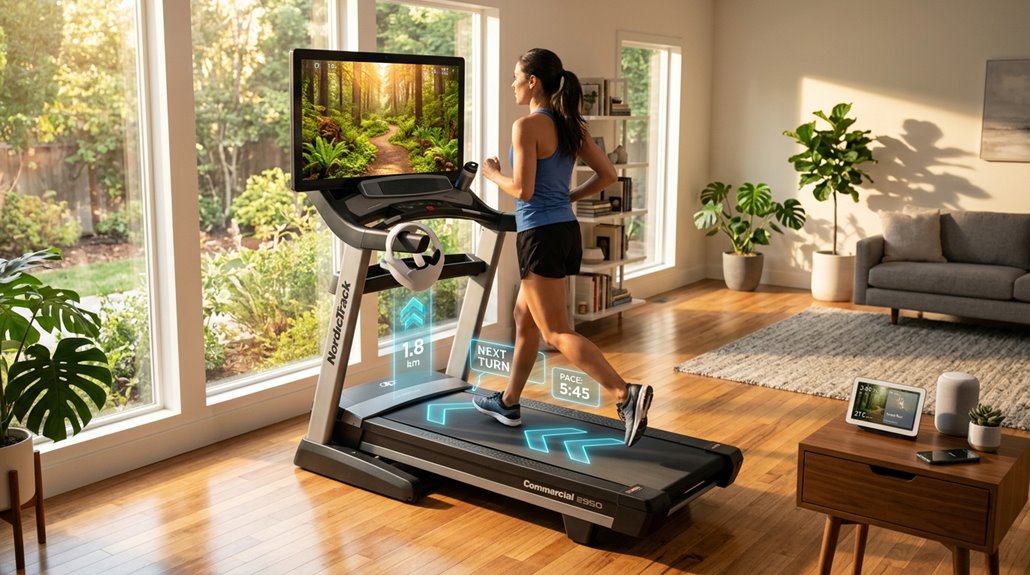
Stepping onto a mixed‑reality treadmill feels like diving into a video‑game gym, where the screen isn’t just a flat wall but a whole world that nudges you to jog through a park, dodge virtual shoppers, or sprint across a beach. The experience instantly boosts virtual engagement, because the scenery changes faster than a TV channel, and it forces the brain to stay on its toes, delivering constant cognitive stimulation.
Older adults report that the immersive feel makes the workout feel less like a chore and more like a fun adventure, and they start looking forward to the next session, just like kids waiting for the next level in a game.
Immersive workouts feel like adventures, turning chores into eagerly awaited, game‑like sessions.
The technology pairs a special treadmill with a VR headset, turning a plain walk into a shopping spree down a virtual mall or a stroll along a sunlit trail. While participants navigate these environments, they must adjust their stepping patterns to avoid obstacles, switch lanes, and respond to random distractions.
This multitasking mimics real‑world challenges, sharpening balance and postural control. Studies show that seniors who train in this way experience a noticeable drop in fall incidents—down from nearly twelve falls per six months to about six—far better than those using a treadmill alone. The obstacle courses and varied pathways keep the mind busy, reinforcing the link between physical movement and mental agility.
Beyond safety, the mixed‑reality approach lifts mood and motivation. The playful graphics and gentle competition encourage longer sessions, which translate into measurable health gains. Participants often see improvements in weight management, BMI, skeletal muscle mass, and even a reduction in body fat percentages.
The added fun factor means they’re more likely to stick with the routine, turning a once‑boring treadmill into a daily highlight. Anecdotes from users describe how they feel like explorers, laughing when a virtual pigeon swoops past, and how that laughter actually makes the workout feel lighter.
In short, mixed reality transforms a static piece of equipment into a lively, interactive playground that blends physical exercise with mental challenges. The blend of virtual engagement and cognitive stimulation not only makes seniors smile but also strengthens their bodies, sharpens their minds, and cuts down the risk of falls.
It’s a win‑win that feels less like therapy and more like a friendly game with friends, proving that technology can make aging a bit more vibrant, one step at a time. VR‑infused treadmill training has been shown to improve walking speed, step length, and balance. The study’s significant drop in fall incidents underscores the effectiveness of this approach.
Similarly, smart home technology has evolved to support active aging, as Amazon Echo devices rely on Alexa’s voice assistant software to help seniors set reminders, play music, and control their environment hands‑free.
References
- https://www.youtube.com/watch?v=JgKeM6Rt5qw
- https://www.withpower.com/trial/virtual-reality-treadmill-training-for-aging-87ad5
- https://dl.acm.org/doi/fullHtml/10.1145/3613904.3642281
- https://www.ktvu.com/news/virtual-reality-treadmills-help-prevent-falls-in-elderly
- https://www.foxnews.com/health/virtual-reality-treadmills-help-prevent-falls-in-elderly
- https://pmc.ncbi.nlm.nih.gov/articles/PMC6840501/
- https://pmc.ncbi.nlm.nih.gov/articles/PMC12384874/
- https://www.scribd.com/document/830304667/Acute-effects-of-virtual-reality-treadmill
- https://cme30.eu/virtual-reality-and-treadmill-training-could-help-prevent-falls-in-older-adults/