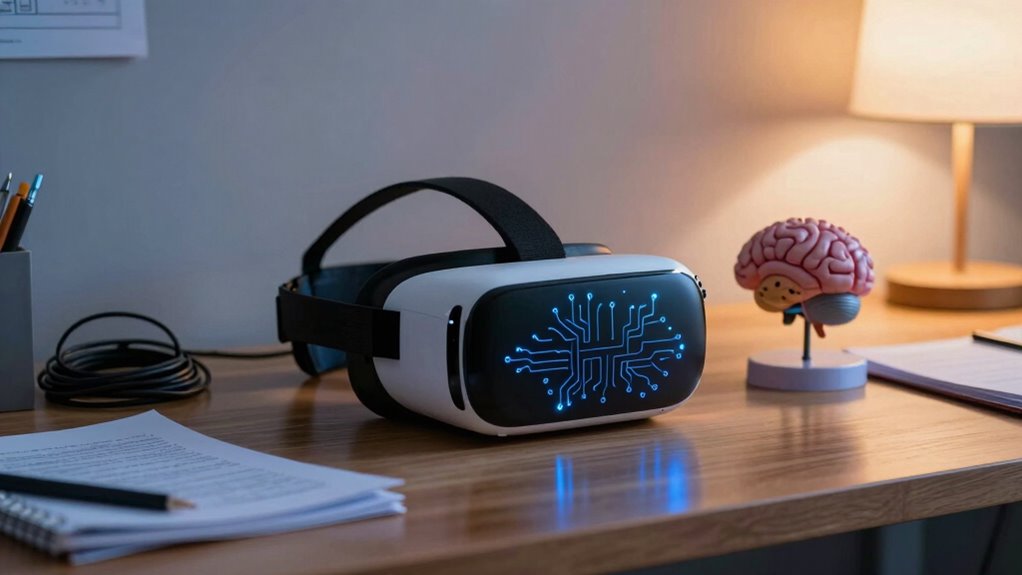
While traditional video conferencing platforms have become ubiquitous tools for maintaining long-distance relationships, a recent UCSB clinical trial funded by the National Institutes of Health reveals that virtual reality technology delivers measurably superior outcomes for fostering authentic social bonds among older adults, particularly those experiencing cognitive decline.
Virtual reality outperforms standard video calls for strengthening social connections in older adults with cognitive impairment, NIH-funded research confirms.
The study examined 186 dyads across eight countries, each consisting of an older adult with mild cognitive impairment or mild-to-moderate dementia paired with an adult child residing at a distance, comparing weekly sessions on the Rendever VR platform against standard Zoom video calls over one month with follow-up assessments at one and three months.
Both modalities enhanced social bonds and psychological well-being metrics, yet VR demonstrated unique supplementary benefits by enabling shared experiential adventures—including virtual boat excursions in Thailand, safari expeditions, and Barcelona cathedral tours—that generated substantively richer conversation patterns and joint emotional experiences exceeding conventional video call interactions.
Researchers identified VR as particularly advantageous in contexts where video conferencing risks devolving into repetitive or health-focused dialogue, providing novel, cognitively stimulating shared activities that qualitatively deepen connection intensity.
UCSB’s broader research initiative explicitly targets authentic new friendship formation among older adults through shared VR environments designed for repeated group interactions, incorporating initial Zoom meet-and-greet sessions for participant introduction followed by regular VR gatherings where participants reconnect in shared digital spaces.
The intervention includes virtual concerts, movie screenings, and facilitated “visits” to personally meaningful historical locations, creating shared memory structures that support developing interpersonal relationships over extended timeframes according to attachment theory principles and adult close relationship science frameworks. Similar to how Alexa+ technology enhances everyday tasks through personalization and proactive suggestions, the long-term vision includes developing low-cost, widely accessible VR-based social programs potentially covered by insurance and available across diverse and rural populations.
Pilot data from 21 resident-family pairs demonstrated that joint VR sessions reduced loneliness indicators, improved mood assessments, and enhanced overall quality-of-life measures for older adults in senior living facilities while simultaneously reducing caregiver guilt among family members. The research team recorded behavioral data including body movements and expressions during sessions, using both human annotators and algorithms to classify engagement patterns and correlate them with stages of memory decline.
A subsequent four-week VR group intervention through a behavioral health PROS program involving twelve participants aged sixty and older yielded qualitative evidence of increased connectedness feelings and reduced loneliness, with participants requesting continued access and reporting substantially greater engagement levels compared to traditional social programming alternatives.
References
- https://news.ucsb.edu/2025/022285/nih-backs-ucsb-virtual-reality-project-help-older-adults-build-real-social-connections
- https://news.ucsb.edu/2021/020413/uniting-generations
- https://pmc.ncbi.nlm.nih.gov/articles/PMC11468973/
- https://behavioralhealthnews.org/using-virtual-reality-to-address-loneliness-and-increase-social-connectedness-in-a-personalized-recovery-oriented-services-pros-program-for-older-adults/
- https://macinc.org/research/virtual-reality-and-seniors/
- https://www.rendever.com/partners/nih-ucsb
- https://longevity.ucsb.edu/news/all/2021/older-adults-staying-connected-virtual-reality
- https://www.cbsnews.com/philadelphia/news/virtual-reality-improving-seniors-lives-and-relationships-research-health/
- https://www.youtube.com/watch?v=Z-Dn6BiGTno
- https://escholarship.org/content/qt6b1362rn/qt6b1362rn.pdf?t=py0x3q