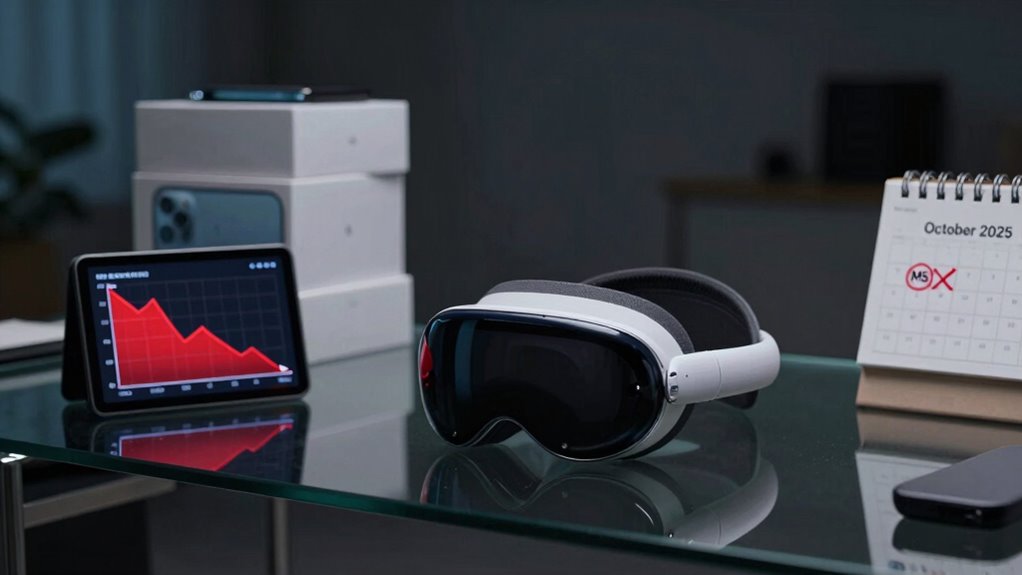
Even though Apple promised the future was here with the Vision Pro, turns out most of us are still waiting for the “affordable” and “lightweight” version—because the M5 upgrade, while slicker with better battery life and a comfier headband, didn’t fix the biggest issue: it still costs more than a used car.
Seriously, $3,499? That’s not a headset, that’s a down payment. And even with the snazzier M5 chip in the October 2025 refresh, sales projections are tanking faster than a bad Wi-Fi signal at a family reunion. IDC guessed only 45,000 units would ship in Q4 2025—that’s a cratering 95% drop from earlier numbers, and embarrassingly small when you compare it to how many iPhones fly off shelves every morning. Expected shipment of 45,000 new Vision Pro units in the latest quarter of 2025.
$3,499 for a headset? That’s a down payment on a car—meanwhile, sales are tanking faster than Wi-Fi at a family reunion.
Apple won’t confirm official sales, but when your supplier, Luxshare, halts production and cuts output “significantly,” you know things aren’t going great.
Consumer feedback isn’t helping either. Sure, VR pilots and medical pros love testing it for training—no arguing there. But average folks? They’re like, “Put $5,000 on my face just to watch Netflix?” Nope.
The app ecosystem‘s another buzzkill: only about 3,000 visionOS-native apps exist, which sounds like a lot until you remember the iPhone had way more, way faster. Without cool, must-have apps, why bother buying one? It’s a classic chicken-and-egg problem—few people buy it, so developers ignore it, which means fewer people buy it. Round and round.
And let’s talk comfort. The new headband helps, but the thing’s still heavy, batteries die fast, and Siri? Same old sleepy assistant. The timing seems especially unfortunate considering that by 2030, many households will already have specialized robots handling everything from cleaning to security without requiring a massive headset.
Meanwhile, Apple quietly slashed digital ad spending by over 95%, especially in big markets like the US and UK. No ads, no excitement, no new countries getting it in 2025—just silence.
Bottom line? The M5 upgrade was a nice polish, but it didn’t fix the real problems. Price too high, apps too few, and sales projections? More like sales regrets. Maybe version 2.0 will finally feel like the future we were promised—lighter, cheaper, and actually for the rest of us initial shipment of 390,000 units during launch window in 2024.
References
- https://www.macrumors.com/2026/01/02/vision-pro-still-failing-to-catch-on/
- https://www.iphoneincanada.ca/2026/01/01/apple-slashes-vision-pro-production-as-sales-fall-short/
- https://www.tomsguide.com/computing/vr-ar/apple-reducing-vision-pro-spending-after-underwhelming-sales-heres-what-we-know
- https://virtual.reality.news/news/apple-vision-pro-sales-plunge-95-as-production-halts/
- https://apple.gadgethacks.com/news/apple-vision-pro-sales-plummet-despite-m5-chip-upgrade/
- https://www.gadgets360.com/wearables/news/apple-vision-pro-production-marketing-demand-sale-decline-report-10201306