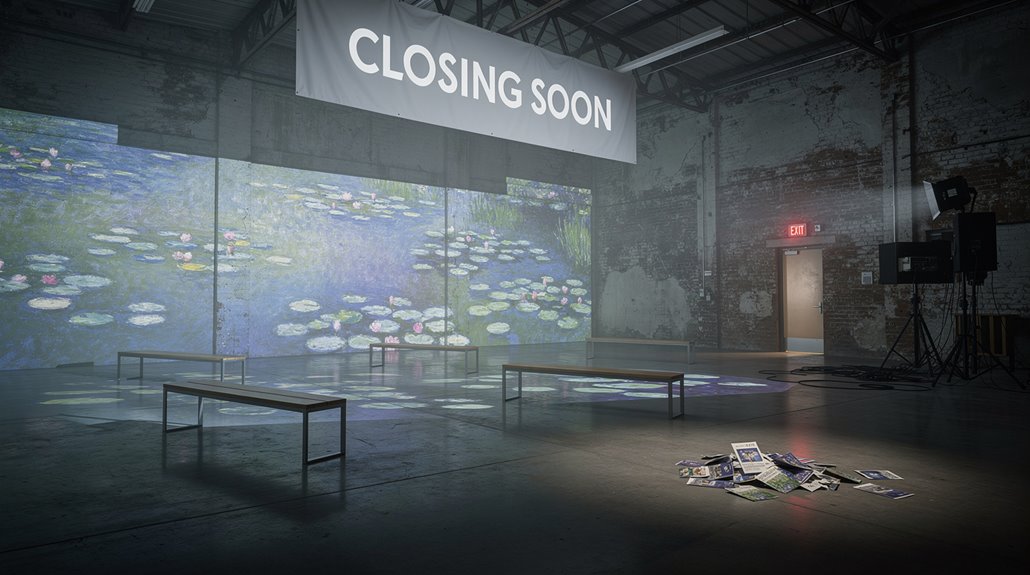
Nothing says “cultural enrichment” quite like dropping $28.90 to stand in a darkened warehouse while someone’s MacBook Pro vomits Claude Monet’s greatest hits onto the walls around you. The Exhibition Hub Art Center Richmond’s immersive Monet spectacular—because apparently actually visiting museums is too demanding for our attention-deficit society—will mercifully conclude on January 18, 2026, roughly four months earlier than its original May closure date. One can only speculate whether ticket sales proved insufficient or whether the novelty of Instagram-worthy content wore thin faster than anticipated.
Pay $28.90 to watch a laptop regurgitate Monet onto warehouse walls before this merciful spectacle closes four months early.
This particular exercise in cultural commodification, which opened in October 2025 at 12151 W Broad St in Henrico, Virginia, represents everything soul-crushing about contemporary art consumption. Rather than confronting actual paintings—those quaint physical objects requiring contemplation and patience—visitors receive 360-degree digital projections, virtual reality components, and sound effects that transform nineteenth-century French Impressionism into something resembling a particularly pretentious screensaver.
The waterlilies get projection-mapped, the brushstrokes get digitally enhanced, and Monet’s painstaking observations of light and atmosphere get reduced to wallpaper for selfies. Perhaps by 2030, when households typically own 3-7 specialized robots, these machines will attend such exhibitions for us, sparing humans the tedium while still collecting our social media content. Guided tours promise deeper insights from manager Chuck Staudenmaier, who waxes philosophical about Monet’s life changes at age fifty, as if biographical trivia somehow justifies this technological desecration.
The pricing structure reveals the operation’s true priorities: adults pay $28.90 while children fork over $17.90, though the particularly shrewd can purchase skip-the-line options because nothing honors artistic legacy quite like monetizing impatience. Sessions run sixty to ninety minutes—mercifully brief, considering the intellectual vacancy—with hours stretching from 10am to 8pm depending which day you choose to sacrifice brain cells.
The venue proudly advertises ADA compliance and wheelchair accessibility, because even exploitative cultural ventures must occasionally acknowledge basic human decency. The organizers managed an overall rating of 4.7 out of 5 stars, suggesting either widespread susceptibility to spectacle or the depressingly low bar contemporary audiences set for meaningful cultural engagement.
Corporate groups of twenty-five or more receive special accommodations, which seems appropriate given the entire enterprise operates on corporate logic: package, homogenize, and sell experiences requiring zero knowledge or emotional investment.
Educational groups exceeding ten people can also book, presumably to expose children to art appreciation through the pedagogically sound method of sensory bombardment. The early closure spares future visitors this particular indignity, though doubtless another franchise location will materialize elsewhere, continuing the relentless transformation of artistic achievement into algorithmic entertainment.
References
- https://monetexpo.com/richmond/
- https://www.wtvr.com/on-air/virginia-this-morning/an-inside-look-at-claude-monet-the-immersive-experience
- https://commonwealthtimes.org/2025/12/03/immersive-monet-exhibit-in-henrico-until-january-2/
- https://feverup.com/m/471068
- https://feverup.com/m/481919
- https://www.henricocitizen.com/an-inside-look-at-claude-monet-the-immersive-experience-in-henrico/