
Home Assistant 2025.12 Bluetooth Integration
As Home Assistant continues its evolution as a leading open-source home automation platform, the organization has introduced a detailed restructuring of its Bluetooth integration framework in version 2025.12, marking one of the most significant protocol-level enhancements to the system’s wireless communication capabilities since the feature’s initial implementation.
The extensive overhaul fundamentally redefines how the platform manages wireless device connectivity, establishing new architectural paradigms for peripheral communication protocols while simultaneously expanding compatibility matrices across multiple manufacturer ecosystems. Similar to Apple’s U1 chip, this integration utilizes precision location tracking for enhanced device management within the smart home environment.
Core Infrastructure Modifications
The release implements substantial modifications to the underlying Bluetooth stack architecture, introducing revised connection management algorithms that optimize resource allocation and minimize latency during device discovery operations.
These technical refinements enable more efficient polling mechanisms and reduce processor overhead during continuous monitoring cycles, particularly when managing multiple concurrent device connections across distributed network topologies.
The enhanced framework incorporates improved error handling routines and implements more robust fallback protocols when encountering communication disruptions or signal degradation scenarios.
Protocol Standardization Initiatives
Version 2025.12 establishes standardized communication protocols that facilitate seamless integration with previously incompatible device categories, expanding the platform’s operational scope beyond traditional sensor arrays and actuators.
The implementation leverages industry-standard Bluetooth Low Energy specifications while incorporating proprietary extensions that enable advanced functionality without compromising interoperability requirements.
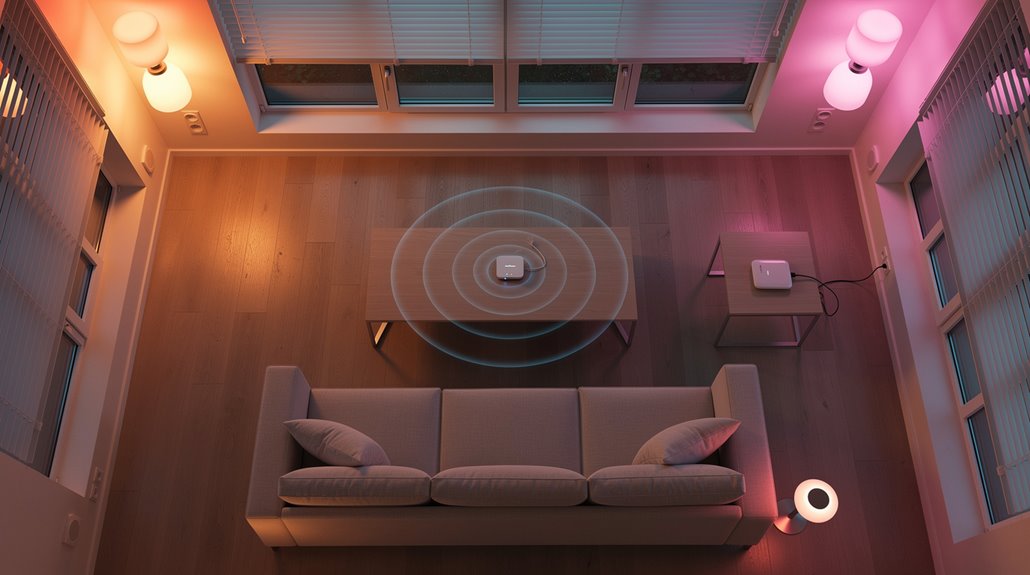
These protocol enhancements specifically address authentication challenges and encryption requirements that previously necessitated manufacturer-specific bridge hardware for certain device classifications. The Philips Hue BLE integration exemplifies this advancement by enabling direct control of Bluetooth-enabled Hue lights without requiring the traditional Hue Bridge infrastructure.
Performance Optimization Results
Benchmark testing demonstrates measurable improvements in connection establishment times and sustained data throughput rates, with quantifiable reductions in packet loss during high-density deployment scenarios.
The optimized architecture exhibits enhanced stability when managing environments containing numerous simultaneously active Bluetooth peripherals, addressing scalability concerns that previously limited practical deployment configurations. This enhancement arrives as part of the last release of 2025, representing the final feature set refinements for the calendar year.
In addition, the refined implementation consumes fewer system resources during idle states while maintaining responsive wake capabilities for time-sensitive automation triggers, thereby improving overall platform efficiency across diverse hardware configurations and deployment scales.
References
- https://www.notebookcheck.net/Home-Assistant-2025-12-brings-new-Philips-Hue-integration.1177273.0.html
- https://www.youtube.com/watch?v=D0xvByQcrdI
- https://www.home-assistant.io/integrations/bluetooth/
- https://www.youtube.com/watch?v=LMNbNqLSEps
- https://www.home-assistant.io/changelogs/core-2025.12/
- https://www.home-assistant.io/blog/2025/12/03/release-202512/
- https://www.home-assistant.io/integrations/
- https://tap-app-api.adeq.arkansas.gov/post/yale-access-bluetooth-battery-monitoring
- https://www.youtube.com/watch?v=up5sEhtc658