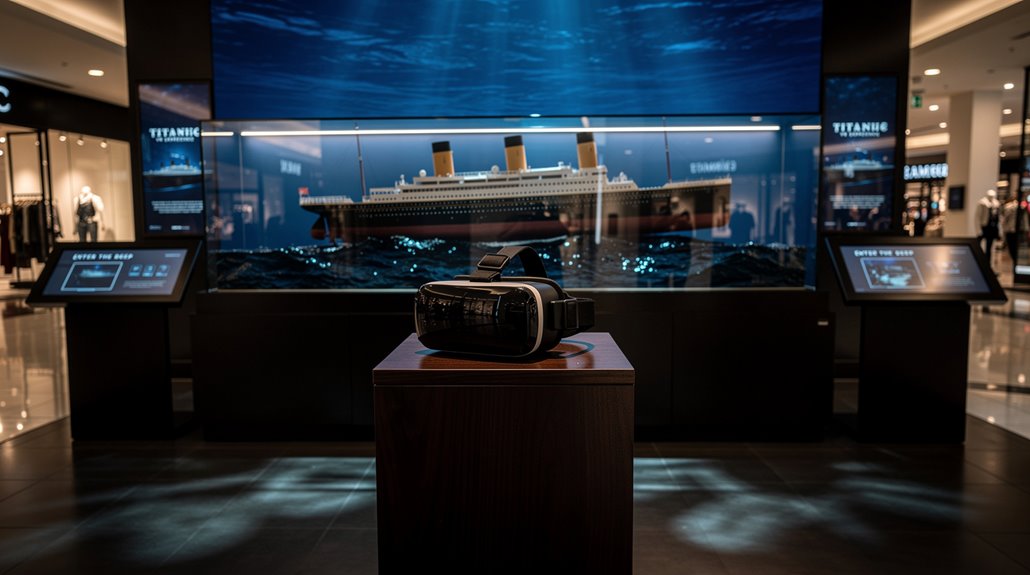
While most people possess the good sense to recognize that 1,500 frozen corpses represents a tragedy rather than a theme park opportunity, Orlando has decided—with the moral compass of a particularly ambitious carnival barker—to transform the Titanic disaster into a virtual reality attraction at The Florida Mall.
Located conveniently next to Sephora, because nothing says “maritime catastrophe” quite like proximity to overpriced cosmetics, this technological wonder allows visitors to cosplay as doomed aristocrats for the price of admission.
Nothing commemorates 1,500 deaths quite like a mall kiosk wedged between fast fashion and a pretzel stand.
The experience begins with guests receiving boarding passes designating them as first-class passengers, sparing everyone the authenticity of third-class accommodations where actual human beings drowned behind locked gates. Participants can unpack virtual luggage, sample digital fruit, and explore opulent cabins—fundamentally LARPing wealth while the historical Irish immigrants who actually perished remain conveniently absent from this sanitized narrative.
The Grand Staircase, those legendary dining rooms, all meticulously recreated so tourists can Instagram themselves into maritime disaster chic.
For those craving proletarian authenticity, the engine room offers coal-tossing activities, transforming backbreaking labor performed by working-class crew members into a whimsical gesture, as though shoveling coal into furnaces was some quaint historical curiosity rather than grueling work that ended in watery graves.
The collaboration with Musealia experts apparently guarantees historical accuracy, though one suspects the “accuracy” excludes uncomfortable details about class-based survival rates and corporate negligence. The attraction also features interactions with passengers and crew, allowing visitors to discover personal stories of those aboard while conveniently packaging human tragedy into digestible narrative snippets. The entire spectacle unfolds over 55 minutes of virtual reality immersion, just enough time to trivialize mass death without testing anyone’s attention span.
The attraction’s pièce de résistance involves descending 3.8 kilometers to witness the actual wreck site, treating a mass grave like an aquatic zoo exhibit.
This virtual descent to ocean depths provides what the promotional materials breathlessly describe as a “once-in-a-lifetime experience,” because apparently gawking at the final resting place of 1,500 people through VR goggles represents peak educational programming.
The Florida Mall’s Fever Hub has fundamentally perfected the American talent for commodifying tragedy, packaging human suffering into digestible entertainment modules complete with interactive elements. Much like how Echo devices rely on Alexa’s software to function, this attraction depends on technological spectacle to mask the ethical void at its core.
One almost admires the entrepreneurial audacity required to transform “preventable disaster caused by corporate hubris” into “immersive storytelling experience.”
It’s disaster capitalism meets disaster tourism, proving that nothing—absolutely nothing—remains too sacred for commercialization when there’s money to extract from historical calamity.
References
- https://titanicexperiencevr.com/orlando/
- https://feverup.com/m/466539
- https://newsroom.feverup.com/en-US/257486-step-aboard-the-world-s-most-famous-ship-through-a-stunning-virtual-reality-adventure-at-orlando-s-florida-mall/
- https://titanicexperiencevr.com
- https://www.youtube.com/watch?v=Imru3necXRE
- https://expo-titanic.com
- https://rmstitanicinc.com/exhibitions/titanic-orlando/