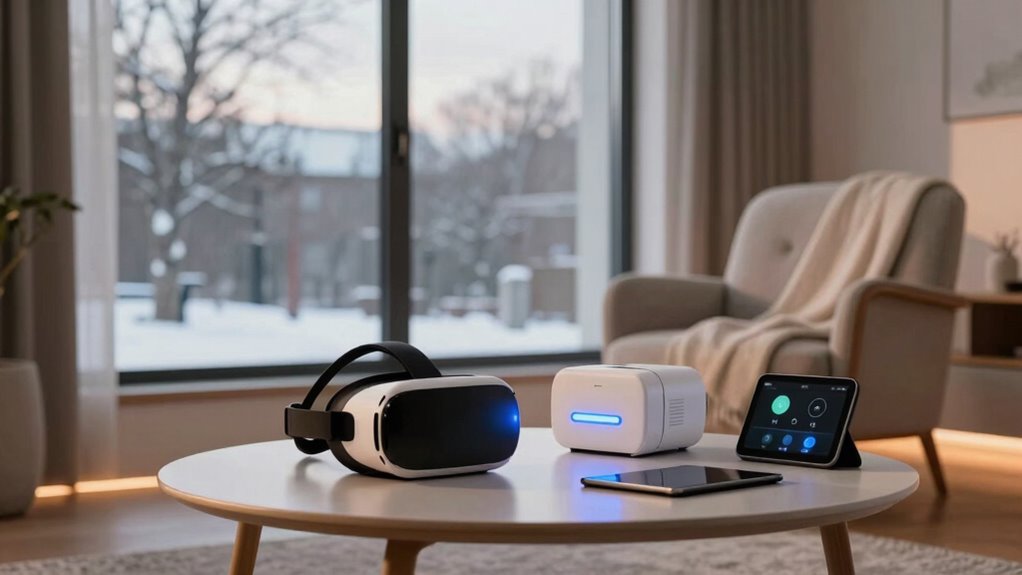
While winter’s gloomy skies might make you want to hibernate like a bear who skipped leg day, science is fighting back—with virtual reality headsets. And no, this isn’t just gamers dodging homework in a digital fantasy world. Researchers are testing VR as a legit challenger to those clunky light boxes that have long been the go-to for Seasonal Affective Disorder (SAD), which hits about 1 in 20 people in the UK when the sun plays hide-and-seek for months.
The cool part? Ten minutes in a sunny virtual environment every morning might work just as well as 30 minutes staring at a glowing rectangle like it owes you money.
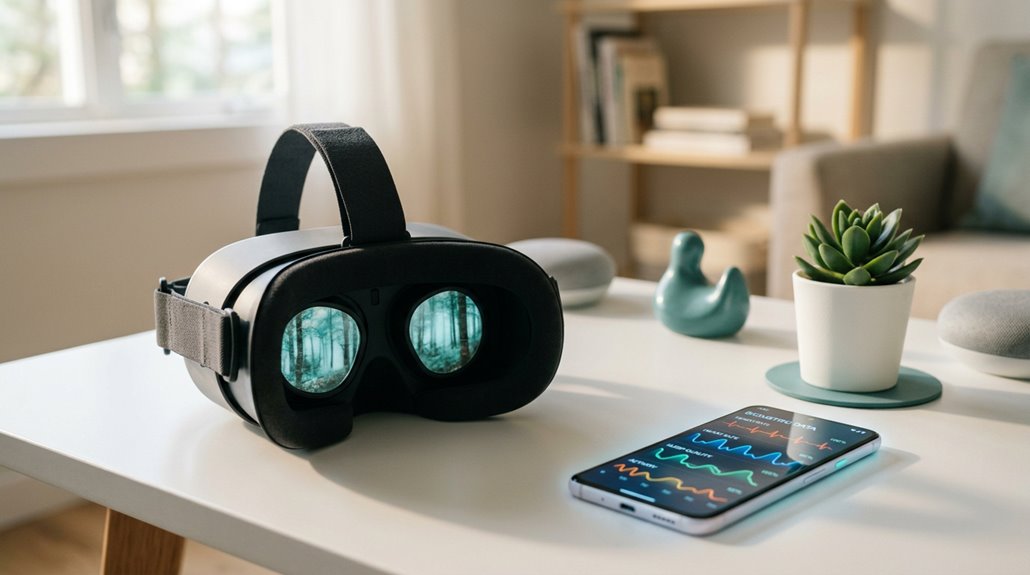
The VR-SAD trial pitted 10-minute daily VR sessions against 30-minute light therapy, both within the first hour of waking for two weeks. Participants zipped into headsets and were instantly transported—no coat, no boots, just instant beach vibes or forest trails bursting with life.
These fully immersive experiences block out the grey outside world, giving the brain a “reset” button. Thanks to 360-degree audio and strong presence, users feel like they’re actually there, which helps with emotional regulation, stress resilience, and yes, even self-compassion (turns out, seeing a kinder version of yourself as a virtual avatar helps silence that inner critic).
VR’s immersive worlds don’t just distract—they rewire your mood, using 360-degree sights and sounds to boost resilience, calm, and self-compassion in minutes.
Mood lifted fast—like, post-session fast. Veterans in the program saw anxiety drop by 14.5% and depression by 12.3%, numbers that rival real-world therapy.
And get this: VR therapy matched Zoom counseling in connection quality, but with a twist—people found the virtual environments more calming and restorative. Plus, 75.8% of meta-analyses show VR helps depressive symptoms, and when paired with CBT, it’s as effective as in-person treatment.
This growing efficacy is supported by the fact that 98% of mental healthcare professionals have adopted telepsychology since 2020, highlighting a broader shift toward technology-driven mental health solutions.
Sure, most studies are from low-quality trials, and adoption at home is still slow—but standalone headsets make this doable. Similar to how household robots are expected to become commonplace between 2028 and 2035, VR therapy devices may follow the same adoption curve as costs decrease and technology improves.
The best part? It inspires people to actually go outside afterward. One veteran joked, “I started hiking for real, ’cause the virtual waterfall made me remember nature wasn’t just slush and sad pigeons.”
Science 1, winter sadness 0.
References
- https://clinicaltrials.gov/study/NCT07161570
- https://pmc.ncbi.nlm.nih.gov/articles/PMC12016277/
- https://pmc.ncbi.nlm.nih.gov/articles/PMC12569364/
- https://www.frontiersin.org/journals/virtual-reality/articles/10.3389/frvir.2024.1281017/full
- https://med.stanford.edu/news/insights/2024/04/depression-virtual-reality-vr-headset.html
- https://www.brainsway.com/knowledge-center/virtual-reality-and-depression/
- https://mental.jmir.org/2021/9/e29681/
- https://www.research.va.gov/currents/spring2015/spring2015-23.cfm