Google Nest’s ceaseless vanishing act is a masterclass in corporate negligence—a circus where flaky Wi-Fi chips collide with half-masked firmware updates, all choreographed by Google’s infamously neglectful server outages. Add the relentless sabotage from microwaves and clueless routers waging IP wars, plus app “upgrades” that break more than fix, and voilà: your thermostat turns into a ghost in the machine. For those who crave the full horror show behind this digital sabotage, further illumination awaits.
Why does the so-called “smart” Google Nest insist on ghosting its users with maddening frequency? The charm of a “smart” home device losing signal because it’s sheltering behind a piece of furniture or a pesky wall is exquisite irony served cold. One might expect modern wizardry to triumph over mere physical obstructions, yet Nest remains tethered to the whims of distance and signal dilution.
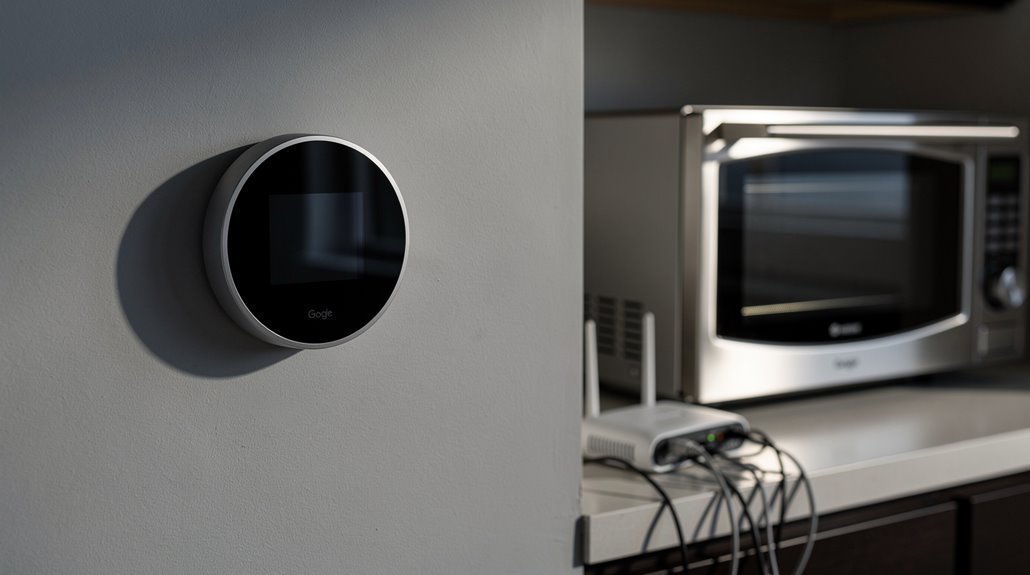
It’s almost quaint how a microwave oven or a cordless phone — relics of the last millennium — can disrupt the delicate dance on the 2.4GHz band, leaving the Nest gasping for connectivity like a fish out of water. Even corporate behemoths can’t seem to prevent channel crowding when neighbors’ Wi-Fi routers battle for airspace like territorial alley cats. Added to these woes, many users have reported that after migrating their Nest devices to the Google Home app, their devices are treated as offline, exacerbating connectivity frustrations. Sometimes, the problem lies not just with local interference, but with a failure in the communication bridge between the thermostat and home.nest.com servers, causing the device to appear offline despite a working Wi-Fi signal communication failure.
Then, there’s the elegant tragedy of outdated software, the Achilles’ heel of any “smart” utopia. Devices lumbering along on obsolete firmware versions, hungry for patches that might fix connectivity issues, are expected to perform miracles. Meanwhile, the Google Nest app, tasked with orchestrating this symphony of convenience, displays the stubbornness of an ancient mule, often incompatible or lacking essential updates.
Users stare dumbfounded as bug fixes—basic as breathing—remain withheld, turning what should be seamless interaction into a Kafkaesque ordeal.
Router misconfigurations add another layer to this dark comedy. Dual routers fighting over IP addresses, security protocols turning into gatekeepers of misery, and DNS settings behaving like rebellious adolescents guarantee the Nest’s social anxiety peaks.
Not to be overlooked are the account and linking nightmares where devices either never quite join the party or cling desperately to accounts long since abandoned, mimicking a ghost ship adrift in cyberspace.
One cannot forget the servers themselves—the invisible puppeteers—conveniently deciding that outages and maintenance are peak hours for chaos. While users interested in cross-platform functionality can enable the Google Nest skill in the Alexa app to control their Nest devices, this does little to solve underlying connectivity issues.
Add in hardware hiccups: dead batteries, flaky Wi-Fi chips, or power adapters as reliable as a politician’s promise, and the “smart” label bestowed upon the Nest seems more a cruel joke than a technological reality.
The Google Nest’s incessant disappearing act is less a glitch and more a reflection of corporate indifference dressed as innovation.
Frequently Asked Questions
How Do I Reset My Google Nest to Factory Settings?
To factory reset a Google Nest device, use the Google Wifi app’s settings or locate the physical reset button. Hold it for 10-15 seconds until lights or sounds confirm reset initiation, then wait several minutes for completion.
Can Google Nest Devices Work With Third-Party Smart Home Systems?
Google Nest devices can work with third-party smart home systems through Google Home app integration, Matter protocol support, and compatible skills. However, functionality may be limited, requiring device compatibility checks and potentially using hubs or automation tools like IFTTT.
What Are the Differences Between Google Nest and Google Home Devices?
Google Nest devices offer integrated smart home experiences and improved features like enhanced audio, more microphones, and unified control via the Google Home app. Google Home represents the older line, now largely phased out in favor of Nest branding.
How Do I Update the Firmware on My Google Nest?
Firmware on a Google Nest updates automatically over Wi-Fi. Users can manually check via the Google Home app under Device settings, selecting Software update. The device restarts post-installation, ensuring peak performance with the latest features and fixes.
Can I Use Google Nest Without a Wi-Fi Connection?
Google Nest cannot fully function without Wi-Fi. It loses remote access, notifications, and app connectivity, though some safety features like smoke detection work locally. Most smart functionalities depend on an active internet connection to operate properly.
References
- https://support.google.com/googlenest/answer/9234146?hl=en
- https://www.androidcentral.com/accessories/smart-home/older-nest-cameras-struggle-terribly-with-offline-issues-in-google-home
- https://www.googlenestcommunity.com/t5/Nest-Thermostats/Nest-App-says-Offline-but-I-am-online/m-p/276486
- https://www.hollyland.com/blog/tips/nest-camera-offline-but-wifi-working
- https://www.youtube.com/watch?v=QKG6ICG77fI
- https://support.google.com/googlenest/answer/6246619?hl=en
- https://support.google.com/googlenest/answer/9252162?hl=en
- https://support.google.com/googlenest/answer/7073477?hl=en
- https://www.youtube.com/shorts/lup_HiYAZ88
- https://www.youtube.com/shorts/EV2ayar2f9k