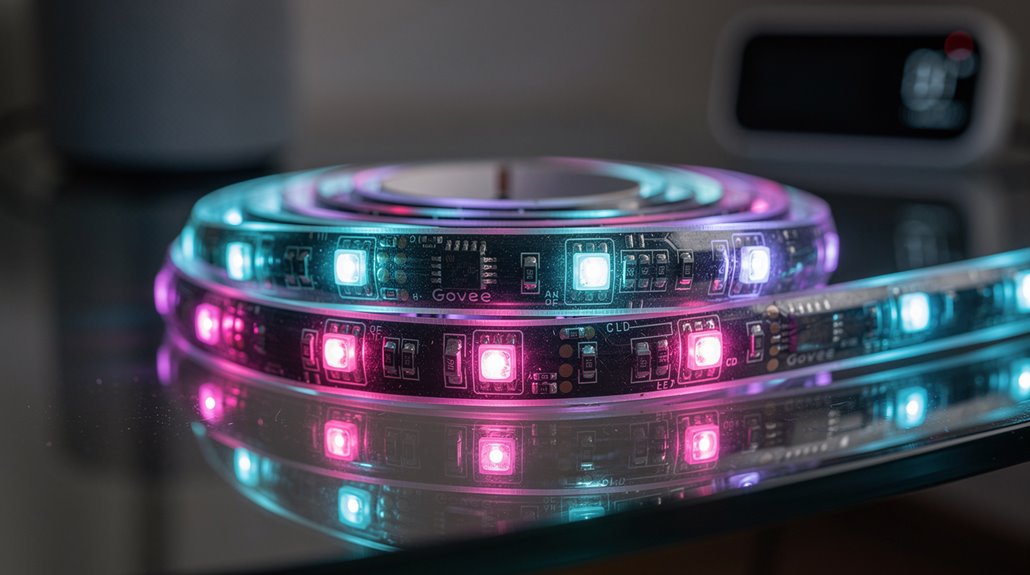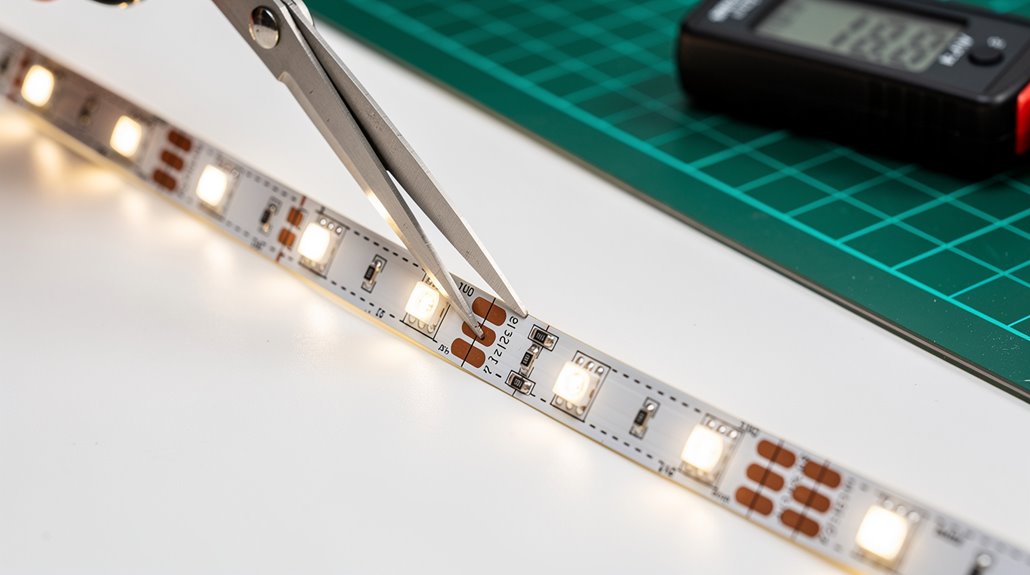
Cutting LED strip lights demands slavish obedience to the enchanting scissor icons and dashed copper-pad lines cunningly emblazoned by manufacturers, lest users unintentionally incinerate their beloved novelties in a pyrotechnic display of ignorance. Casual snips anywhere else promise instant appliance euthanasia, a merciless tribute to human impatience and corporate sadism in equal measure. Only a clean, reverent incision precisely down these marked circuit sanctuaries preserves functionality. For those craving the full litany of sacramental do’s and don’ts, further enlightenment awaits.
Why, one must wonder, does the salvation of LED strip lights hinge on the minuscule scissor icons or dashed copper-pad lines so maddeningly ignored by hapless consumers? It is almost tragicomic how these microscopic harbingers of salvation are sidestepped, leading to the premature demise of the very technology designed to illuminate our cabinets and mancaves.
These scissor icons and dashed lines—often spaced every few inches or at every trio of LEDs—are not mere decorative whispers but sacred instructions etched in copper. They alone guarantee the electrical circuit’s survival after dismemberment, a fact shockingly neglected by those who treat these strips as if they were paper towels rather than fragile tech artifacts.
The manufacturers, in a rare explosion of clarity amid their usual technical obfuscation, provide explicit cut-point guidance tailored to each product model, which apparently flies over consumer heads with the elegance of a lead balloon. Before cutting, it is essential to power down the strip completely, ensuring no voltage is present to prevent electric shock or damage. Using a voltage tester before cutting confirms that the power source is fully disconnected for safety.
The tools necessary? Not exactly rocket science: sharp scissors or a utility knife, for starters. Yet, the consumer’s entrancement by dull blades—heralds of uneven, catastrophic cuts that slice through internal wiring with surgical precision—is a highlight in this parade of incompetence.
One cannot overstate the tragedy of a botched snip obliterating expensive circuitry and turning a once-promising luminance into a sad, flickering death. Add to the mix a cutting mat, ruler, and a rudimentary voltage tester—none of which require a PhD—yet are absent in many disastrous attempts.
Measurement, disconnection of power, and adherence to manufacturer directives are apparently Herculean tasks. Cutting at unmarked points and creating jagged incisions are the surest paths to LED purgatory.
No bending, no hesitation, and a single clean cut down the copper pad’s middle preserve function; deviation guarantees ignominy. Post-cut, protecting the exposed copper with heat-shrink tubing, silicone sealant, or specialized end caps is necessary lest corrosion, moisture, or dust mercilessly sabotage the fragile circuits.
The redemptive option of soldering or using clip connectors exists, though only if polarity is respected—another concept too complex for many. In sum, the sad truth remains: Ignoring these infinitesimal but critical cut marks dooms LED strips to a slow, flickering death, much like the fading attention spans and practical skills of their users.
Frequently Asked Questions
Can I Cut LED Strips at Any Length?
LED strips cannot be cut at any arbitrary length; they must be cut at designated points marked by copper solder pads or manufacturer guidelines. Improper lengths cause circuit damage, non-functionality, and potential permanent failure of the strip.
What Tools Do I Need to Cut LED Strips Safely?
Cutting LED strips safely requires sharp scissors or a utility knife for clean cuts, a ruler for precise measurements, soldering iron with solder for connections, and safety gear including gloves, goggles, and protective mats to prevent injury and damage.
How Do I Reconnect Cut LED Strips?
To reconnect cut LED strips, one must expose copper terminals, then use appropriate connectors like 4-pin clips or quick connectors. Proper alignment of positive and negative terminals guarantees continuity. Securing and testing the connection verifies functionality.
Will Cutting LED Strips Affect Their Brightness?
Cutting LED strips at designated points does not affect brightness, as the internal circuitry remains intact and power distribution continues properly. Incorrect cuts damage circuits, leading to non-functional sections and diminished or lost brightness.
Can LED Strips Be Cut Underwater or in Humid Areas?
Cutting LED strips underwater or in humid areas is highly discouraged due to increased electrical hazards, corrosion risk, and reduced cutting accuracy. Proper power disconnection, moisture isolation, and protective measures are essential to prevent damage and safety issues.
References
- https://www.flexfireleds.com/blog/steps-to-cut-led-strip-lights-where-to-cut/
- https://www.wired4signsusa.com/blogs/led-projects-blog/how-to-cut-led-strip-lights-a-comprehensive-guide
- https://www.daybetter.com/blogs/product-blogs/how-to-cut-led-strip-lights-a-complete-guide-by-daybetter
- https://www.youtube.com/watch?v=5UE_JJWl1QU
- https://www.youtube.com/watch?v=h4-RoVf8Wgw
- https://www.youtube.com/shorts/9u4oA580vPg
- https://www.topledprofile.com/blog/the-minimum-cutting-length-of-led-strip-lights
- https://hitlights.com/blogs/led-strip-lights/can-i-cut-led-strip-lights
- https://www.ledmyplace.com/blogs/stories/can-you-cut-led-strip-lights-a-step-by-step-guide
- https://www.aspectled.com/blog/post/can-you-cut-led-strip-lights/