Govee light strips generously offer copper-plated “cut here” signals that mimic GPS waypoints but with far less reliability—cutting them demands scalpel precision on these microscopic pads lest users doom their expensive plastic serpents to electrical purgatory. The manufacturer’s vague warnings are as helpful as a screen door on a submarine. Sharp scissors only, no guesswork, or face functional apocalypse. If one has the nerve, connecting fragments requires soldering skills bordering on witchcraft. A full reckoning of this litany of calamities awaits ahead.
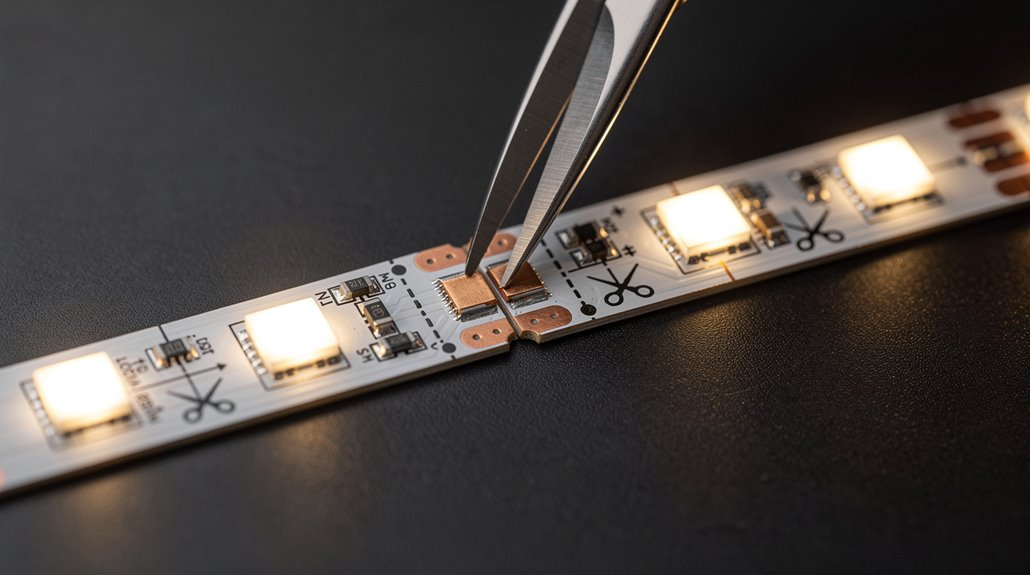
If one harbors the masochistic urge to slice into a Govee light strip—because who doesn’t relish paying for an LED strip only to discover it’s as straightforward to cut as a Fort Knox vault—there is a sliver of hope: the designated cutting points. These are not mere suggestions or vague illusions of user empowerment but actual, copper-plated beacons of salvation. Govee thoughtfully stamps scissor icons aplenty, marking where one may, without sinning against circuitry, sever the strip.
These cutting points appear with clockwork monotony every few inches, their precision betrayed only by the sinister copper pads, glinting like tiny gladiator arenas where electricity fights to survive the cleaver’s descent. Cut here, and the strip miraculously continues to light up your life—or at least your living room—without a spectral flicker of betrayal. However, cutting these strips is not recommended by the manufacturer due to risks in functionality.
Every few inches, copper arenas await the blade’s judgment—cut right, and the light endures unbroken.
Armed with these cutting beacons, the user soon discovers the unforgiving necessity of sharp scissors or utility knives, tools sharper than a corporate exec’s moral compass. The method demands clean, precise incisions, for dull instruments release fraying chaos that mocks the concept of “user-friendly.” The cutting must slice directly through these copper crucibles—neither too far, lest it maim LEDs and circuitry, nor too short, which invites electrical doom.
This ritual mandates surgical accuracy because, obviously, in a world of consumer electronics, the margin for error cannot dip below nanometer thresholds.
Before the butchery commences, a pilgrimage through the product manual—often buried in PDF obscurity—is vital. Govee’s RGBIC strips embody particular arrogance; some simply refuse to be chopped thanks to their individual chip sovereignty. Ignoring this fact is a torpedo to functionality, sentencing the strip to bleak obsolescence.
Additionally, LEDs asthma their way along every two inches or so, enforcing rigid geography on cutting plans, while 90-degree turns are betrayed by the very presence of these clustered bulbs, forcing awkward, defensive reroutes in strip layout.
Finally, to reconcile severed pieces, the world of soldering and connector cables awaits—the latter offering the faintest hope for continuity in this fragmented LED dystopia. Here ends the chaotic dance of brass and blade, illuminating the sad truth: the dream of customizable lighting is a fragile illusion, painstakingly maintained by copper and tempered by user despair.
Frequently Asked Questions
How Do I Connect Multiple Govee Light Strips Together?
Multiple Govee light strips connect via specialized connectors or by directly linking compatible models like M1. Alternatively, the Govee Home app groups strips for synchronized control. Proper power and voltage management are essential to avoid performance issues.
Can Govee Light Strips Be Controlled via Voice Assistants?
Govee light strips can be controlled via voice assistants such as Alexa, Google Assistant, and Matter-compatible devices. This allows users to adjust color, brightness, and scenes through voice commands, enabling seamless smart home integration and automation.
What Power Adapter Do I Need for Govee Light Strips?
The power adapter for Govee light strips depends on the model, typically requiring 36V for outdoor types or 12V for universal compatibility. Wattage ranges from 40W to 100W, with round tip connectors ensuring proper fit.
Are Govee Light Strips Waterproof for Outdoor Use?
Govee light strips with an IP65 rating are waterproof and suitable for outdoor use. Their durable silicone construction withstands dust and low-pressure water jets, ensuring reliable performance on patios, gardens, and various exposed exterior surfaces throughout the year.
How Do I Reset My Govee Light Strip Controller?
To reset the Govee light strip controller, unplug it, hold the power button for 5-10 seconds, plug it back in while holding, and continue holding until lights flash. This enters pairing mode, completing the reset process.
References
- https://eu.govee.com/blogs/product-review-blog/becoming-a-master-at-cutting-led-lights-a-comprehensive-guide
- https://www.youtube.com/watch?v=37zy_Z3Dcm8
- https://www.youtube.com/watch?v=onP-9ayIR9o
- https://www.youtube.com/watch?v=eG4sKOmZW9k
- https://www.youtube.com/watch?v=pMqrp9RdQEU
- https://community.govee.com/posts/cutting-strips/267250
- https://www.youtube.com/watch?v=iAa0y0-H_-g
- https://www.youtube.com/watch?v=FahKoPtIyiY
- https://www.coohom.com/article/can-you-connect-two-govee-light-strips-together
- https://www.youtube.com/watch?v=zqmrbmNFF8g