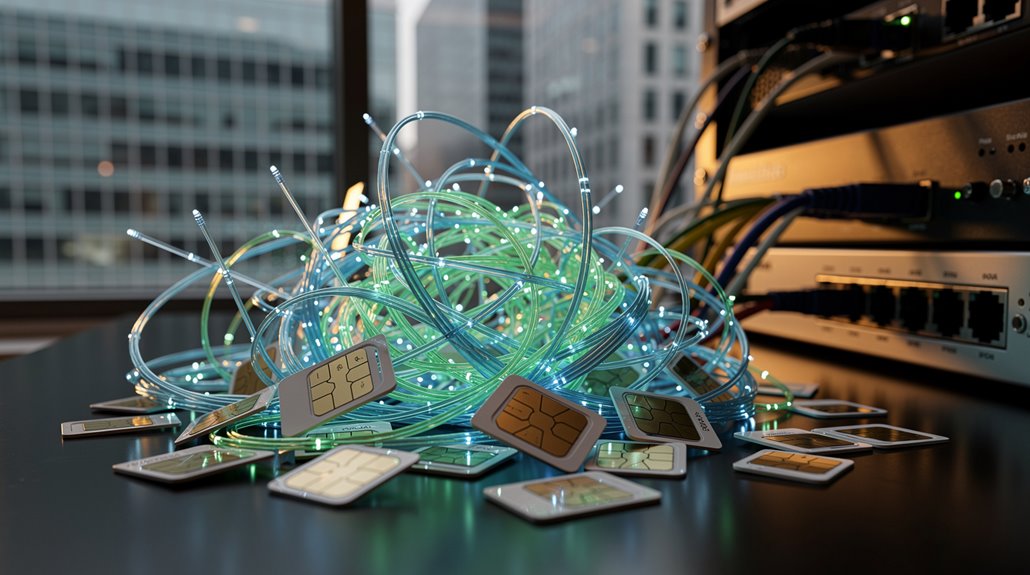
Ting masquerades as a nimble innovator in telecom but stumbles through a labyrinth of corporate ineptitude and regulatory farce, juggling mobile plans that charge by usage—because flat rates are too simple—and fiber services promising gigabit speeds with no caps, yet bogged down by bankruptcy shadows cast by parent EchoStar. Their “customer-first” facade clashes with messy brand splits and expansion flops, showcasing how noble intentions drown in institutional chaos. For those curious about how tragedy and farce entwine, there’s more to unravel.
Ting, an offspring of Tucows, epitomizes the modern telecommunications farce: born in 2012 to navigate the labyrinthine world of mobile and fiber internet services, it juggles two identities while serving as a cautionary tale of corporate sprawl and regulatory dodgeball. Founded as a Tucows subsidiary, this American internet provider deftly straddles domains, simultaneously hawking mobile virtual network operator (MVNO) services and gigabit fiber internet—because why simplify when you can muddle your brand identity across divisions?
Ting’s dual hustle in mobile and fiber—confusing brand, clear corporate chaos.
Its headquarters in Charlottesville, Virginia, now resemble a bureaucratic theater of the absurd, with additional offices in Starkville, Mississippi, presumably to remind customers that confusion isn’t limited by geography. Ting also operates in Durango, Colorado, expanding its fiber internet footprint beyond the East Coast with a focus on underserved areas through its fiber internet access.
Originally cozying up with Sprint in 2012 for mobile service, Ting Mobile flirted with T-Mobile’s GSM network until December 2019, only to be dumped into Verizon’s CDMA embrace come September 2022—proof that loyalty in telecom land means nothing, except perhaps prolonged customer bewilderment.
Meanwhile, Ting Mobile lords over phone tethering without contracts or subsidies, as if daring users to cling to decency in a sea of fine print and surprise charges. This darling of consumer-friendly policies charges for what you actually use—a quaint notion in an industry addicted to flat-rate gouging—and lets users wield their own routers via optical network terminals since 2016, a gesture of mild rebellion against ISP control freakery.
Ting Internet, spun off post-2020 Dish acquisition, tosses symmetrical gigabit fiber without bandwidth caps into underserved markets, having snapped up Blue Ridge Internetworks and expanded greedily into 19 additional locales.
Sprinkling free gigabit access to community hubs reads as PR gloss on an otherwise oligopolistic landscape starving such ventures of true competition. Its acquisition spree included Cedar Holdings and Tucson’s SimplyBits, yet the parent company EchoStar’s June 2025 Chapter 11 filing hints that financial mismanagement trumps technological innovation in the end.
Ting’s annual $171.5 million revenue belies a skeletal 201-500 employee count struggling beneath corporate inertia and regulatory gamesmanship. Support for makerspaces and open internet campaigns might warm the heart, if only such gestures weren’t overshadowed by systemic failures.
This double-faced enterprise—flitting between fiber optic utopia and mobile network musical chairs—stands as emblematic of an industry equally skilled at innovation and institutional farce.
Frequently Asked Questions
How Does Ting’s Customer Service Compare to Other Carriers?
Ting’s customer service, once superior to major carriers, now matches or falls below typical industry standards due to significant declines post-DISH acquisition, marked by delayed responses, unskilled offshore staff, communication barriers, and unresolved billing issues.
What Devices Are Compatible With Ting’s Network?
Compatible devices include released iPhones from SE 2nd Gen onward, Samsung Galaxy A and S series, Motorola G-series with 5G, budget flip phones, and released phones checked via Ting’s IMEI compatibility tool for T-Mobile and Verizon networks.
Can I Keep My Phone Number When Switching to Ting?
Number porting to Ting is generally supported, allowing users to keep their existing phone numbers. The transfer typically completes within hours to days depending on the number type, requiring account details and a compatible compatible device.
Are There Any International Calling Plans With Ting?
Ting does not offer specific international calling plans but provides pay-per-use rates for international long-distance calls. Customers must meet eligibility requirements, including account standing and service duration, before accessing these features for various destinations.
How Does Ting Handle Overage Charges or Data Limits?
Ting imposes no overage charges; instead, data speeds throttle to 128 kbps after the high-speed allowance depletes. Throttling persists until the billing cycle resets or a data top-up is purchased, ensuring uninterrupted service.
References
- https://en.wikipedia.org/wiki/Ting_Inc.
- https://en.wikipedia.org/wiki/Ting_Mobile
- https://www.ting.com/about-us
- https://leadiq.com/c/ting-internet/5a1d9d4923000053008d22e5
- https://www.zoominfo.com/c/ting-internet/373625310
- https://tingmobile.com/about
- https://seamless.ai/b/ting-internet-22574183
- https://www.connectbase.com/provider/ting-internet/
- https://www.trustpilot.com/review/ting.com
- https://www.bbb.org/us/co/englewood/profile/mobile-phone-service/ting-mobile-1296-1000115986/complaints