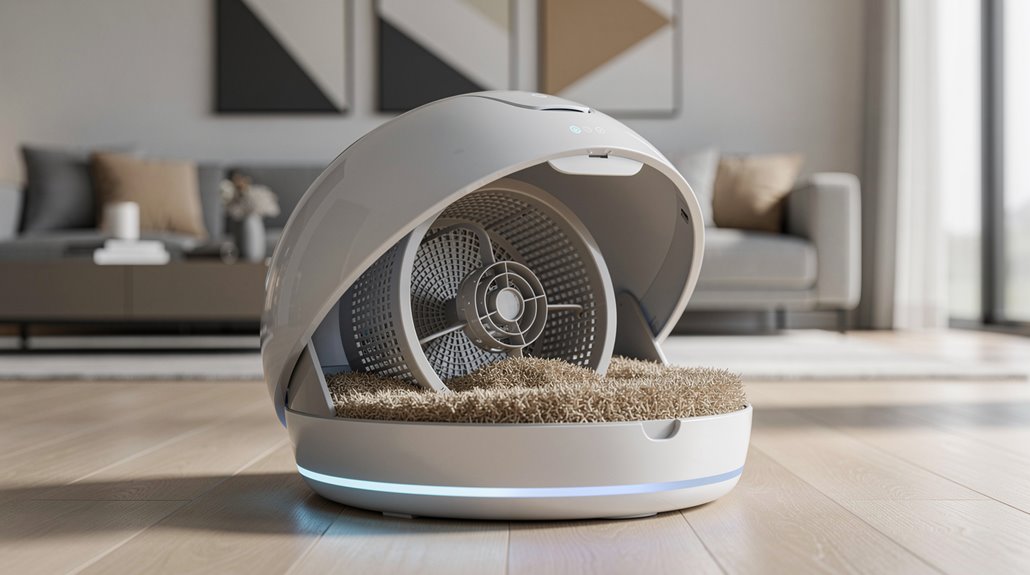
The Litter-Robot—a glorified, rotating plastic shrine to humanity’s declining willingness to scoop litter—promises to roboticize cat waste disposal with laser sensors and hermetically sealed chambers, charging upwards of $799 for an ironclad excuse to ignore basic chores. Accommodating everything from baby kittens to corpulent felines, it transforms scooping into a luxury tech spectacle, flaunting Weight Sensors and WasteID Smart Technology while mocking traditional care. For those craving convenience steeped in hubris, the mechanized charade only deepens. More awaits beyond this snarky introduction.
In an epoch where consumer gadgets masquerade as life-enhancing miracles, the Litter-Robot emerges as the emblematic crowning achievement of humanity’s tragic decline—an automatic, rotating litter box engineered to separate feline excrement from the almond-hull bath, as if cats were alien dignitaries requiring a TSA-level cleanse.
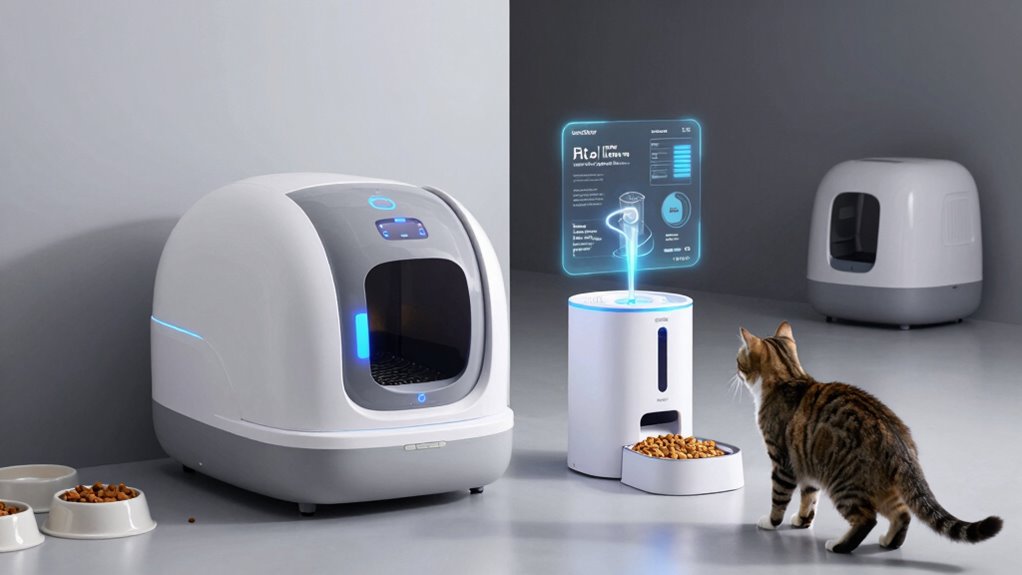
This rotating globe, patented and proudly assembled on American soil—because, naturally, mass outsourcing would sully the sanctity of mechanized litter purification—relies on gravity and a fine-tuned sifting mechanism to perform its noble task. It accommodates a broad demographic spectrum, from scrappy 3-pound kittens to obese 30-pound felines, and even boasts the audacity to handle a multiverse of up to five cats, imagining a bustling feline United Nations within one compact, glorified chamberpot. The latest model also features the OmniSense Detection System, which uses mechanical and laser sensors to ensure the cleaning cycle starts only after the cat exits. Designed for up to five cats, the Litter-Robot 5 carries a premium price starting at $799, denoting its luxury status in the realm of pet care.
The cleaning cycle, triggered by an unassuming timer the instant the cat flees from its porcelain throne, initiates a rotation designed to capture waste with impeccable precision, depositing detritus into a hermetically sealed chamber where clumps and odors are meant to suffocate away from human nostril assault.
Once the feline departs, a silent, precise rotation banishes waste into an airtight vault of olfactory oblivion.
Adjustable delays cater to the skittish, a cruel nod to anxiety-ridden pets who distrust technology more than their hapless owners. OmniSense Detection System technology, a cacophony of laser and mechanical sensors, guarantees no accidental cycles mar the delicate balance of feline dignity by waiting for an orderly exit—a level of surveillance warranting envy from Big Brother himself.
Weight sensors, capturing minute differences as small as a pound, audaciously track individual cats, while a drawer full indicator spares owners the torment of accidental overflow, a catastrophe presumably rivaling Flint’s water crisis in household urgency.
WasteID Smart Technology extends the farce by differentiating urine from feces, ostensibly to optimize odor control—a feature growing in prowess over a crucible of thirty days and revealing grimmer insights within the Whisker app.
Silent motors and modular design promise discreet cleansing and user-friendly disassembly, complemented by an LCD display and customizable LEDs for the utmost in aesthetic self-indulgence. Meanwhile, weight-tracking and AI-powered facial recognition in the Pro model chronicle feline health with Orwellian zeal, converting waste disposal into a dystopian saga of biometric surveillance.
The Litter-Robot is not merely a box; it is a towering monument to how modern “innovation” cynically commodifies the mundane, botching empathy for convenience and crowning humanity’s descent with a mechanized throne of self-delusion.
Frequently Asked Questions
How Often Do I Need to Empty the Waste Drawer?
The waste drawer should be emptied once weekly for one cat, twice weekly for two cats, every 2-3 days for three cats, and every 1-2 days for four or more. Notifications and indicators assist in timely emptying.
Can the Litter-Robot Accommodate Multiple Cats?
The Litter-Robot accommodates multiple cats, supporting up to four per unit in models 4 and 5, while the EVO fits two. Proper ratios reduce stress and maintain hygiene, requiring more frequent waste drawer emptying in multi-cat homes.
What Maintenance Does the Unit Require?
The unit requires weekly litter level checks, pressing the reset button after adjustments, basic globe cleaning every 1–3 months, deep cleaning every 3 months, careful base cleaning without soaking, and monthly carbon filter replacements.
Is It Noisy During Operation?
The Litter-Robot 4 operates quietly, averaging 40-55 decibels, with peaks around 59 decibels due to QuietSift technology. Its whisper-quiet engine minimizes disturbance, benefiting noise-sensitive cats and owners, unlike louder previous models.
What Type of Litter Works Best With the Litter-Robot?
Clumping clay-based litter works best with the Litter-Robot. Fast, tight-clumping formulas enhance waste separation and removal. Specific brands, like GreatLitter and Tidy Cats, are optimized, while non-clumping, pellet, and paper litters fail to sift properly.
References
- https://cats.com/how-does-the-litter-robot-work
- https://www.litter-robot.com/litter-robot-5.html
- https://www.whisker.com/litter-robot-5
- https://www.litter-robot.com/litter-robot-5-pro.html
- https://www.litter-robot.com/how-it-works.html
- https://www.whisker.com/litter-robot-comparison-chart
- https://www.goodhousekeeping.com/home-products/a40510449/litter-robot-4-review/
- https://www.litter-robot.com/litter-robot-evo.html
- https://www.youtube.com/watch?v=Q5jZ4OYXdns
- https://www.whisker.com/explore-litter-robot