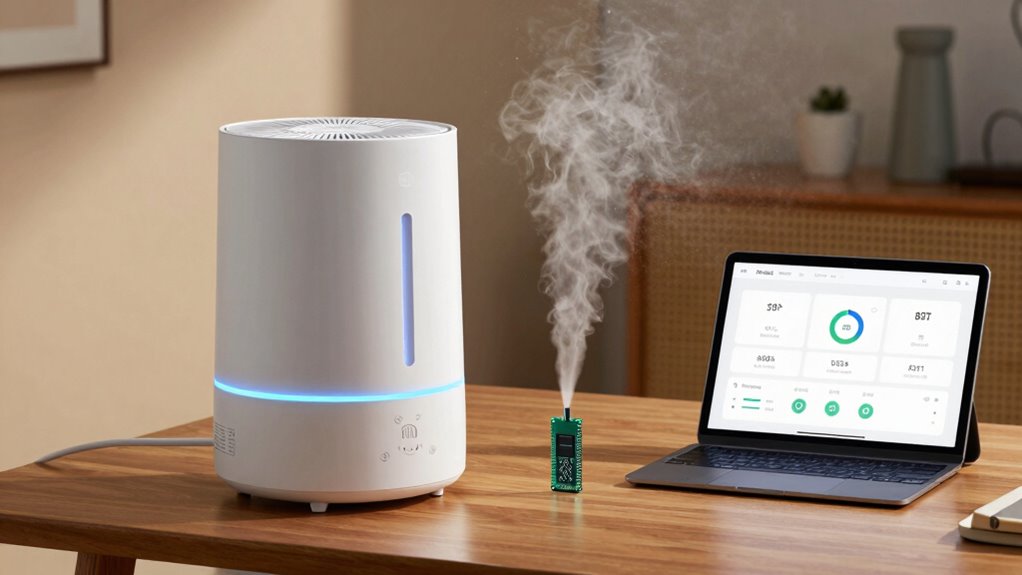

Introduction to the Xiaomi Smart Humidifier Hack reveals a significant advancement whereby a developer has engineered a custom firmware solution that eliminates the Xiaomi Smart Humidifier 2’s reliance on Xiaomi’s cloud infrastructure, thereby granting local control via the Home Assistant platform. This modification detaches the device from the proprietary Mi Home application ecosystem, which traditionally governs user interactions and operational commands.
The innovation protects the product from enforced obsolescence mechanisms, permitting uninterrupted functionality irrespective of the manufacturer’s cloud service status or internet availability.
This innovation safeguards continuous device operation independent of cloud services or internet connectivity.
Technical specifications underline the Xiaomi Smart Humidifier 2’s operational capacity and features, including a 4.5-liter water reservoir enabling continuous mist output of up to 350 milliliters per hour, adequately servicing an area between 20 and 30 square meters. The ultrasonic humidification method utilizes a dual mist outlet capable of 360-degree rotation to evenly distribute humidity throughout a room, while UV-C sterilization effectively eradicates 99.9% of bacteria, ensuring sanitation. Additionally, the humidifier operates quietly at 32 dB, making it ideal for use during sleep or work without disruption (whisper-quiet operation). The device’s large water tank capacity supports long usage times, contributing to convenience and sustained humidification (4L large water tank).
Designed for quiet operation at 32 decibels, it incorporates a floating plate structure and a top-load water inlet to facilitate consistent moisture release and simplified refilling processes respectively.
The hack introduces significant enhancements by facilitating local device management through Home Assistant, which negates the necessity for cloud connectivity; this autonomy also precludes forced updates or restrictions typically imposed via the corporate app. Such local operation allows integration into broader smart home ecosystems without dependency on external servers or internet connectivity, increasing user privacy and operational reliability in network-constrained environments. Similar to considerations for installing cameras on mailboxes, users should verify that this modification complies with local regulations to avoid potential legal issues with the manufacturer.
Comparatively, the Xiaomi Smart Humidifier 2 stands out against alternative models, such as the Smart Evaporative Humidifier, which offers a slightly higher mist output of 400 mL/h but with reduced water tank capacity and shorter runtime. The Mijia Pro model exceeds both in mist rate and tank size yet operates at a slightly louder 30.7 dB noise level.
The ultrasonic approach employed by the Humidifier 2 contrasts with evaporative systems that rely on antibacterial filters with specified efficacies and require scheduled replacements. The hack’s implication on hygiene features remains compliant with the device’s UV-C sterilization and safety protocols, maintaining integrity while providing an advanced control paradigm.
References
- https://www.mi.com/global/product/xiaomi-smart-humidifier-2/
- https://www.mi.com/global/product/xiaomi-smart-evaporative-humidifier/
- https://www.mi.com/global/product/mijia-smart-evaporative-humidifier-pro/
- https://www.mi.com/global/product/xiaomi-smart-humidifier-2/specs/
- https://xiaomistoreph.com/products/xiaomi-smart-humidifier-2
- https://www.tomshardware.com/maker-stem/microcontrollers-projects/dev-hacks-xiaomis-smart-humidifier-to-free-it-from-the-cloud-now-works-with-home-assistant-locally-custom-firmware-allows-the-product-to-evade-planned-obsolescence
- https://www.youtube.com/watch?v=3VNUjkhBJaw