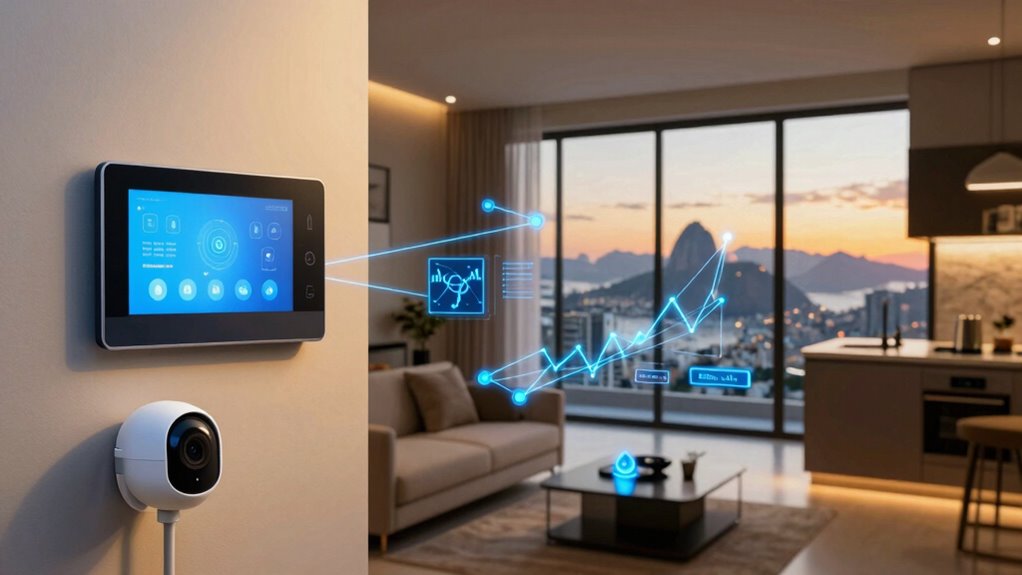
As the integration of Internet of Things (IoT) technologies accelerates across residential sectors, the Brazil smart home market, valued at USD 2.68 billion in 2024, is projected to witness considerable growth, potentially reaching between USD 6.68 billion and USD 45.58 billion by 2033, depending on market adoption rates and innovation trajectories.
Market forecasts vary markedly, with a conservative compound annual growth rate (CAGR) of 10.70% estimating a rise to USD 6.68 billion, while an aggressive scenario predicts an expansion to USD 45.58 billion at a 31.48% CAGR. This dual projection reflects uncertainties linked to consumer adoption rates, technological advancement, and infrastructural developments within the country. Increasing adoption of IoT and connectivity technologies is a primary driver fueling this optimistic growth potential.
Market growth estimates range widely, driven by varying adoption rates and technological progress in Brazil’s smart home sector.
Key segments contributing to this expansion include smart home appliances and security cameras, which are expected to grow from USD 1.19 billion and USD 426.6 million respectively in 2024, reaching USD 2.53 billion and USD 1.65 billion by 2033.
The discrepancy in growth rates—8.69% CAGR for appliances and 16.5% for security cameras—illustrates a heightened consumer focus on safety and surveillance technologies, propelled by increasing urbanization and security concerns in megacities such as São Paulo and Rio de Janeiro. These devices capitalize on IoT connectivity, facilitating remote monitoring, automated controls, and enhanced user data analytics. Smart irrigation systems with environmental sensors are emerging as a significant subcategory, offering automated water conservation through real-time monitoring of soil moisture and weather conditions.
Driving this robust market expansion are several macroeconomic and technological factors: the proliferation of approximately 27.1 billion connected devices globally by 2025, rising disposable incomes within Brazil’s expanding middle class, and a government-supported shift toward sustainability evidenced by an 83% renewable electricity matrix. Additionally, regional variations in technology adoption highlight stronger smart home growth in the South and Southeast regions due to higher urbanization and income levels, forming key regional adoption trends that influence market strategies.
Moreover, rapid urbanization—with around 88% of the population residing in urban areas—creates heightened demand for energy-efficient, automated home solutions that align with both environmental goals and lifestyle shifts toward convenience and security.
Nevertheless, the industry faces considerable challenges that could constrain growth trajectories. High initial installation costs, persistent data privacy and cybersecurity risks, and dependence on proprietary software platforms limit accessibility and consumer trust.
Additionally, considerable capital requirements impose barriers for new market entrants, exacerbating competitive rivalry among existing firms. The evolving competitive landscape is characterized by intensified buyer power and moderate supplier influence, reflecting the dynamic interplay between technological innovation and market entry complexities observed in this burgeoning sector.
References
- https://www.imarcgroup.com/brazil-smart-home-market
- https://www.renub.com/brazil-smart-home-market-p.php
- https://deepmarketinsights.com/vista/insights/smart-home-appliances-market/brazil
- https://straitsresearch.com/report/smart-home-market
- https://www.grandviewresearch.com/horizon/outlook/smart-home-security-camera-market/brazil
- https://deepmarketinsights.com/vista/insights/smart-home-market/brazil
- https://www.statista.com/outlook/cmo/smart-home/brazil
- https://www.researchandmarkets.com/report/latin-america-smart-home-market